Tag Archives: Copper

Cleaner E-Waste #Gold and #Copper Metal Recovery by University of #Edinburgh

A green robotic arm in a recycling facility picks up circuit boards from a conveyor belt filled with electronic waste, with brightly colored containers labeled 'Copper', 'Gold', 'Palladium', and 'Silver' in the background.

The University of Edinburgh has licensed a gold and copper recovery process to mineral processing company Lithium Universe, enabling cleaner extraction of highโ€‘value metals from electronic waste.

Developed by Professors Jason Love and Carole Morrison in the School of Chemistry, and commercialized with support from Edinburgh Innovations, the Gold Copper Diamide Extraction (GCDE) process uses organic compounds to selectively extract metals from discarded electronics.

Under an exclusive agreement, Lithium Universe will deploy and subโ€‘license the technology globally as part of its expanding precious metals recycling strategy.

Eโ€‘waste is one of the worldโ€™s fastest-growing hazardous waste streams, projected to reach around 93.5 million tonnes by 2030, but only about 20% is recycled using environmentally sound methods, the University said.

This waste is valuable, as devices and printed circuit boards are rich in gold and copper. At current prices, the gold content of one tonne of typical eโ€‘waste is worth more than $46,000, with copper adding roughly another $2,000, it estimates.

But traditional eโ€‘waste processing relies on furnace smelting above 1,200ยฐC or aggressive leaching, both energyโ€‘intensive and polluting, the University noted. Its GCDE process instead uses lowโ€‘temperature hydrometallurgy and small, reusable organic ligands to target metals in sequence, under mild conditions and avoiding cyanide, mercury and organic solvent extraction.

โ€œElectronic waste is effectively a highโ€‘grade โ€˜urban oreโ€™. Our goal was to design chemistry that can recover those metals selectively and safely, without the energy and environmental cost of smelting,โ€ Love said in a news release.

โ€œThe diamide behaves like a molecular magnet for gold. By following with a selective copper step, we can recover two of the most valuable metals in eโ€‘waste with high purity and lower environmental impact.โ€

Lithium Universe plans to integrate GCDE into its precious metals recycling division, alongside its silver recovery technologies for endโ€‘ofโ€‘life solar panels.

โ€œThis breakthrough from the University of Edinburgh reinforces the strategic expansion of our precious metals recycling division into high-value recovery technologies,โ€ executive chair Iggy Tan said. By integrating selective metal recovery with sustainable processing, the company would โ€œstrengthen its competitive position in circular-economy solutions for gold, silver and copper recovery,โ€ he added.

#US firm Bridge Green opens #CriticalMineral recovery plant in #Chennai #TamilNadu, #India

An illustrated map of Tamil Nadu highlighting the concept of a circular economy, featuring icons for renewable energy sources like wind turbines and solar panels, as well as various minerals essential for battery production. Key terms include sustain, recover, reuse, and repower, surrounded by recycling symbols.

Bridge Green Launches Critical Mineral Recovery Plant in Chennai to Advance Battery Circularity

In a significant step toward building a circular battery economy, US-based startup Bridge Green Upcycle has inaugurated a state-of-the-art critical mineral recovery facility in Chennai, Tamil Nadu, India.

Strengthening India’s Battery Recycling Ecosystem

Located in Gummidipoondi near Chennai, the newly commissioned plant is designed to process end-of-life lithium-ion batteries as well as battery manufacturing scrap. With an annual processing capacity of 7,200 tonnes, the facility represents one of the most advanced battery recycling operations in the region.

The plant will recover a range of critical minerals, including:

  • Lithium
  • Cobalt
  • Nickel
  • Manganese
  • Copper
  • Graphite

These materials play a vital role in battery manufacturing and are essential for supporting the growing electric vehicle (EV) and energy storage industries.

Recognition Under Government Incentive Scheme

The facility has been selected under the Government of India’s Critical Mineral Recycling Incentive Scheme, highlighting its strategic importance in strengthening domestic supply chains for critical raw materials. Notably, it is the only facility in Tamil Nadu included in the first cohort of projects approved under the initiative.

Major Investment Plans Ahead

Bridge Green’s Founder and CEO announced that the company plans to invest between โ‚น500 crore and โ‚น1,000 crore over the next five years. The current plant is expected to ramp up operations and reach full processing capacity by the end of this year.

This investment underscores the company’s long-term commitment to developing a sustainable and localized critical minerals ecosystem in India.

Expanding into Refined Battery Materials

Beyond mineral recovery, Bridge Green has outlined ambitious expansion plans. The next phase of development will focus on producing refined battery-grade materials, including:

  • Lithium carbonate
  • Nickel sulfate
  • Manganese sulfate
  • Cobalt sulfate

The company is targeting commissioning of these facilities by the end of 2028. Additionally, plans are underway to establish a second-life battery plant, further extending the lifecycle of battery assets and reducing waste.

Supporting the Circular Economy

As demand for batteries continues to grow worldwide, recycling and material recovery will play an increasingly important role in reducing dependence on virgin mining and improving resource security. Facilities such as Bridge Green’s Chennai plant demonstrate how innovative recycling technologies can help create a more sustainable, resilient, and circular battery value chain.

The launch marks an important milestone not only for Bridge Green but also for India’s emerging critical minerals and battery recycling sector, positioning the country as a key player in the global energy transition.

A key differentiator for Bridge Green is its proprietary technology platform focused on both battery life extension and critical mineral extraction. By combining advanced recycling processes with second-life battery solutions, the company aims to maximize resource utilization while reducing environmental impact.

The company’s strategy extends beyond recycling alone. Bridge Green plans to serve both domestic and international markets, supplying recovered minerals and battery materials to industries including battery manufacturing, chemicals, pharmaceuticals, defence, and aerospace.

In addition to mineral recovery, the company intends to provide second-life battery systems for data centres and industrial users. These systems can repurpose batteries that are no longer suitable for electric vehicles but still retain sufficient capacity for stationary energy storage applications, further supporting circular economy objectives.

Capitalizing on Growing Demand

According to Founder and CEO demand for battery-grade materials already exists in India and is expected to grow significantly as the country’s cell manufacturing ecosystem matures. As domestic battery production expands under various government initiatives, the need for locally sourced critical minerals and refined battery salts will become increasingly important.

Bridge Green is also positioning itself to tap into international opportunities. Potential export markets include the United States, Southeast Asia, and Europeโ€”regions that are rapidly strengthening their battery supply chains and seeking reliable sources of critical minerals.

The recently established USโ€“India Critical Minerals Supply Chain Framework presents an additional opportunity for the company. As a USโ€“India enterprise, Bridge Green is uniquely positioned to support cross-border collaboration in securing sustainable supplies of critical materials required for the global energy transition.

Watch more at:

#China’s Zero-Tariff Policy Boosts #African Trade

Map illustrating trade routes between China and Africa, highlighting key cities and connectivity. Points of interest include trading hubs and growth statistics. Emphasizes partnership and infrastructure development.

As Chinese and African citizens increasingly reap the mutual benefits of trade, America is losing out by heading in the opposite direction.

Source: Opinion; The Washington Post

The State Council; The People Republic of China.

China has expanded its zero-tariff policy to include all 53 African nations with which it maintains diplomatic relations, opening new opportunities for African exports and industrial development at a time when global trade is increasingly affected by protectionist policies.

The policy took effect immediately, with a shipment of 24 tonnes of South African apples becoming the first African products to enter China under the expanded tariff-free arrangement after clearing customs in Shenzhen.

Previously, China had already eliminated tariffs on all product categories from 33 of Africaโ€™s least-developed countries starting December 2024. The latest expansion extends similar benefits to 20 additional African economies, including Kenya, Egypt, and Nigeria. Under the arrangement, these countries will enjoy preferential zero-tariff access for an initial two-year period while China works toward establishing long-term trade agreements through the China-Africa Economic Partnership for Shared Development framework.

According to Chinaโ€™s Ministry of Commerce, the measure will improve the competitiveness of African exports such as cocoa from Cรดte dโ€™Ivoire and Ghana, Kenyan coffee and avocados, and South African citrus fruits and wine, which previously faced tariffs ranging from 8% to 30%. The ministry also believes the initiative will encourage greater investment in Africa by attracting capital, technology, equipment, and management expertise to support local processing industries. This, in turn, is expected to create a more balanced and sustainable trade relationship between China and Africa.

The decision has been widely welcomed as a strong signal of Chinaโ€™s commitment to economic openness during a period when many countries are adopting more restrictive trade policies. African Union Commission Chairperson Mahmoud Ali Youssouf described the move as both timely and beneficial for Africa, noting that the continent continues to face numerous global challenges, including rising protectionism. He expressed appreciation for what he called a gesture of solidarity from China.

China remains Africaโ€™s largest trading partner. Bilateral trade reached a record US$348 billion in 2025, with Chinese imports from Africa totaling US$123 billion, representing year-on-year growth of 5.4%.

Experts believe the impact of the policy will extend beyond trade. Scholars from institutions including Tsinghua University and University of International Business and Economics argue that tariff-free access could encourage multinational companies to establish manufacturing and processing facilities in Africa, supporting industrialization and helping the continent move beyond its traditional role as a supplier of raw materials.

The initiative also aligns with Chinaโ€™s broader economic strategy of expanding international openness and improving trade and investment cooperation through 2030. Analysts suggest that Chinese consumers will benefit as well, gaining access to a wider range of competitively priced African products. Businesses have already begun preparing to increase imports, including Kenyan tea processors that expect significantly lower costs under the new tariff regime.

Overall, the expanded zero-tariff policy is expected to strengthen China-Africa economic ties, boost African exports, attract investment, and support long-term industrial growth across the continent.

Source: The State Council; The People Republic of China.

Quad members (#US, #Japan, #Australia and #India) unveil $20bn #CriticalMinerals initiative

A visually engaging graphic depicting the planet Earth with highlighted continents, featuring the flags of India, Japan, the United States, and Australia. The design emphasizes connections between these countries, labeled 'Critical Minerals QUAD Members,' with glowing effects and illustrations of network lines.

The US, Japan, Australia and India have unveiled a $20 billion framework to strengthenย critical mineralsย supplies as Washington continues to seek ways to loosen China’s stronghold.

The four Quad partners said they intend to raise up to $20 billion in public and private sector support to boost critical minerals supply chains that includes mining, processing and recycling by identifying projects in member countries.

“Through the Quad Critical Minerals Initiative, Quad partners intend to work together to use economic policy tools and co-ordinated investment to accelerate the development of diversified and fair critical mineral markets. and support the supply of critical minerals that are crucial to our regionโ€™s economic growth and security,” the members said in a statement.eย 

Monday’s announcement followed US Secretary of Stateย Marco Rubio’s visit toย India, where he and Quad foreign ministers also announced initiatives to strengthen maritime and transnational security, emerging technology and humanitarian assistance.

Under the critical minerals agreement, the Quad partners said they would support strategic projects through export credit agencies, private capital, development financial institutions, and explore new ways to raise private capital in the critical minerals space.

Critical minerals are used to produce advanced technology, defence systems, electric vehicles and other technologies in the clean energy transition.

Read more at: The National News

#EU seeks to rebalance trade relationship with #China

The European Union must rebalance its trade relationship with China, EU officials said Friday, as Brussels sharpens its focus on economic ties with Beijing.

The EUโ€™s trade deficit with China reached approximately โ‚ฌ360 billion ($418 billion) last year, increasing pressure within the bloc to address the growing imbalance.

EU officials emphasized that while openness to trade remains a core European value, there is a clear need to create a fairer and more balanced trading relationship with China.

The European Commission is expected to hold discussions next week on how the 27-member bloc should approach China to ensure more equal trade conditions. A potential visit by Chinaโ€™s commerce minister to Brussels later next month is also being considered.

European leaders are set to further discuss EU-China trade relations during a summit in Brussels on June 18 and 19.

Trade ministers meeting in Brussels highlighted the importance of maintaining strong economic ties with China, while also stressing the need to reduce strategic dependencies and strengthen Europeโ€™s economic resilience.

Particular concern has centered on rare earth minerals after China imposed export restrictions last year, exposing Europeโ€™s heavy reliance on Chinese supplies. China remains the worldโ€™s leading producer of rare earth elements.

In response to ongoing trade tensions, the EU has introduced measures aimed at protecting its market from what it considers unfair Chinese competition, including additional levies on small parcels imported from China.

Source: CANADIAN AFFAIRS

#CriticalMetals Inks 15-Year #Greenland #RareEarth Deal With #REalloys

Critical Metals said it has โ signed a 15-year binding offtake agreement with โ€‹REalloys for rare earth concentrate from its Tanbreez project โ€Œin Greenland.

Under the agreement, โ€ŒREalloys will buy 15% of annual โ rare earth โ concentrate production from the project, which is one โ€‹of the world’s largest known heavy rare earth deposits.

โ€ข โ€‹The agreement formalizes and expands on a non-binding โ deal signed โ by the companies โ last โ€‹October.

โ€ข It also follows Greenland’s approval in April for Critical โ€‹Metals to โ increase its ownership in the project to 92.5%.

โ€ข Critical Metals said the deal strengthens the commercial outlook for the Tanbreez project as it moves โ toward production.

โ€ข REalloys will receive priority rights to concentrate containing โ higher levels of the critical heavy rare earth elements, dysprosium and terbium, along with a right of first refusal over additional volumes.

โ€ข Deliveries will be made from the Tanbreez port in southern Greenland, with pricing linked to international rare earth oxide benchmarks.

โ€ข United States โ and its allies have stepped up efforts to secure supplies of critical minerals outside China, which dominates much of the global rare earth โ€‹processing industry.

Source: U.S.News

#US Needs Another Decade to Fixย $1.2 Trillionย #RareEarth Crisis

A digital artwork depicting a split scene featuring the White House on the left and a futuristic city skyline on the right, with heavy text overlay discussing heavy rare earth elements dysprosium and terbium, alongside a theme of contrasting colors and visuals.

For the past year, President Donald Trump has waged a campaign to break Americaโ€™s dependence on the rare earths that remain Chinese leader Xi Jinpingโ€™s unbeatable leverage over the global economy.

From White House meetings to boardroom negotiations, US officials and their allies around the world have poured billions of dollars into mining, refining and other industrial facilities. While Beijingโ€™s might was amassed over decades, Trump pledged last November that ending US reliance on rare earths would take just 18 months.

Yet the ones that matter most remain out of reach.

Chinaโ€™s chokehold is likely to loosen on some of the more abundant light rare earths used in a huge proportion of consumer electronics by the end of this decade. But when it comes to some of the key so-called heavy rare earths โ€” essential for high-performance magnets and military technologies and targeted by Chinaโ€™s export curbs last year โ€” Beijingโ€™s dominance will likely persist longer, until at least the mid-2030s, according to projections and data supplied to Bloomberg from three critical mineral consultancies.

For two of the most important elements, dysprosium and terbium, countries outside of China will still meet less than a fifth of demand by 2035, according to data from one of those consultancies, McKinsey & Co. CRU Group and Benchmark Mineral Intelligence offered similar projections and interpretations.

Read more at: Bloomberg

#Nickel associations of #Indonesia, #Philippines sign agreement on cooperation

The nickel associations of Indonesia and the Philippines on Friday signed a memorandum of understanding on nickel cooperation, Indonesiaโ€™s coordinating ministry of economics said.

The agreement includes the exchange of information, joint development of nickel downstream processing technology, and human resource development to support a sustainable nickel industry ecosystem, the ministry said.

The signing was witnessed by Indonesiaโ€™s chief economics minister and the Philippinesโ€™ trade and industry minister.

โ€œThe Philippines will no longer be only an exporter of raw nickel ore as it will be integrated into a higher-value regional supply chain, while Indonesia will secure a reliable supply for its battery and stainless industries,โ€ Philippinesโ€™ trade and industry minister said.

Indonesia exported $9.73 billion of nickel products last year, Airlangga said, adding that smelters in Indonesia required supplies with the proper silicon-to-magnesium ratio which can be supplied by the Philippines.

Source: Mining.com

#Japan tackles challenges of seafloor #RareEarth mining, eyeing economic security

An underwater scene featuring a deep-sea mining vehicle near Japan, with the Japanese flag in the background. The text highlights Japan's advancements in deep-sea technology, referencing a depth of 6,000 meters.

Japan’s government is taking on the challenge of mining critical minerals, including rare earths, from the seabed around Minamitorishima, a remote Japanese island in the Pacific, with an eye to realizing domestic rare earth production in the future.

Securing such minerals is a matter of vital importance for Japan, which is poor in natural resources. In February of this year, the country succeeded in a test collection of rare earth-bearing mud at a depth of 6,000 meters below sea level near the island, which is in the Tokyo village of Ogasawara.

While commercialization is being targeted for 2028 at the earliest, the government faces the challenge of striking a balance between the importance of the mining for economic security and its economic viability.

Rich mineral resources are believed to lie in the ocean floor around Minamitorishima. Cobalt-rich crusts and manganese nodules have been found there. Cobalt and manganese are used for electric vehicle batteries.

Furthermore, the presence of mud containing scarce and expensive heavy rare earth elements, such as neodymium and dysprosium, has also been confirmed, and development is being promoted under government leadership. Neodymium and dysprosium are needed for high-performance motors used in EVs and wind power generators.

“We have promoted technical development over the years to make the world’s first attempt” at deep-sea rare earth mining, said Shoichi Ishii, an official at the Cabinet Office who is leading the rare earth-rich mud development project.

Read more at: Japan Times

#Australia-#Japan Joint Statement on Elevated #CriticalMinerals Cooperation

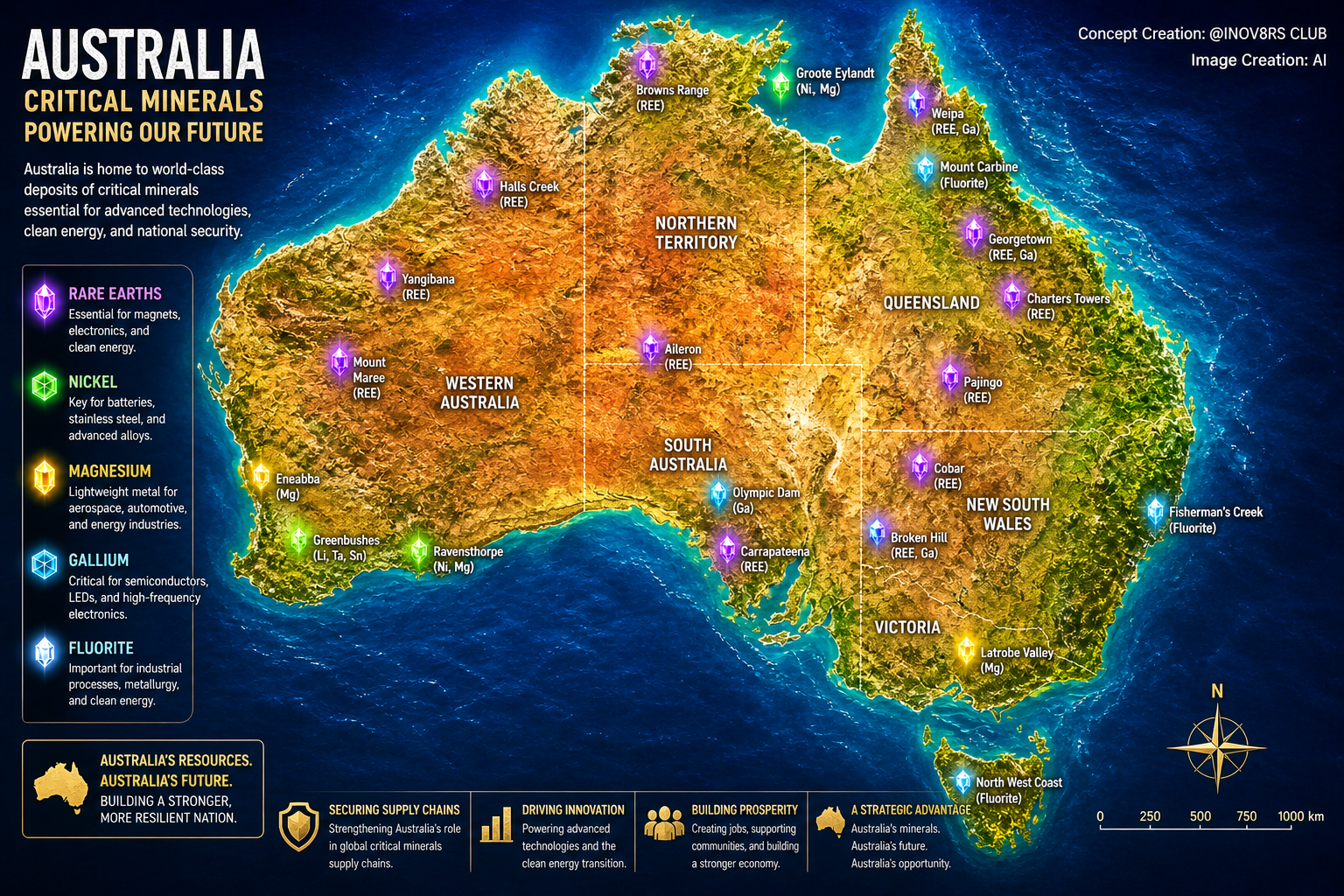
Map of Australia highlighting major regions rich in critical minerals essential for technology, clean energy, and national security. Locations include deposits of rare earths, nickel, magnesium, gallium, and fluorite across various states.

The two Governments have already identified the following key projects that have the potential to materially diversify the supply chains for critical minerals:

  • Lynas Rare Earths Project
    A flagship initiative symbolising collaboration between Japanese and Australian industry on critical minerals. In 2011, a joint venture (JARE) between Sojitz Corporation and JOGMEC provided equity and loan financing to Lynas Rare Earths to commence light rare earth production. In 2025, the project reached a further milestone with the commencement of heavy rare earth production.
  • Alcoa Gallium Recovery Project
    This project involves Alcoa working with Japan Australia Gallium Associates (JAGA)โ€”a joint venture between Sojitz and JOGMECโ€”to develop gallium recovery at one of Alcoaโ€™s operating alumina refineries in Western Australia, for use in semiconductors, LEDs, and solar cells. The project is planning to be supported by equity investment from the Governments of Japan, Australia, and the United States.
  • Magnium Magnesium Project
    Magnium Australia is planning the commercial production of highโ€‘purity magnesium, widely used in lightweight applications including the automotive and aerospace sectors, in Western Australia using a lowโ€‘carbon process with reduced environmental impact. Hanwa Co. Ltd., a Japanese trading company, as well as the Government of Japan, has also expressed interest in this initiative.
  • Tivan Fluorite Project
    The Speewah Fluorite Project, located in Western Australia, is a Japanese Governmentโ€‘supported initiative involving a joint venture between Sumitomo Corporation and JOGMEC, in collaboration with Tivan Limited, to produce acidโ€‘grade fluorite, a key raw material for hydrofluoric acid used in semiconductors, EVs, and other advanced applications. It has also received a non-binding and conditional Letter of Support from EFA.
  • RZ Resources Critical Minerals Project
    The Copi Critical Minerals Project in New South Wales is a mineral sands project, looking to develop supply of critical minerals and rare earth elements, owned by RZ Resources, with participation from JX Metals Corporation and Marubeni Corporation. It has also received non-binding indications of support as a critical minerals project from EFA and the U.S. Export Import Bank.
  • Ardea Resources Kalgoorlie Nickel Project
    The Kalgoorlie Nickel Project โ€“ Goongarrie Hub is one of the largest nickel cobalt resources in Australia. The project is being developed as a joint venture with Ardea Resources, Sumitomo Metal Mining, and Mitsubishi Corporation. The Government of Japan has provided funding support under its economic security grant towards building a resilient and secure critical minerals supply chain. The project has received non-binding and conditional indications of support from EFA and the U.S. Export Import Bank. The Australian Government has selected Ardea to participate in its investor front door pilot, which aims to streamline project engagement with government.

Read more at: Department of the Prime Minister and Cabinet

« Older Entries Recent Entries »