Category Archives: Metals

#SQM says to expand #Lithium production as demand grows

Image result for sqm & lithium

#Chile’s #SQM said it was planning to expand its production of critical rechargeable battery ingredient #Lithium, as demand continues to rocket on the back of its increased use in electric vehicles and mobile phones.

SQM has access to vast mineral reserves in the so-called ‘lithium triangle’ in Chile and #Argentina and is one of the world’s leading producers of the material.

Read more at: http://www.reuters.com/article/sqm-results-idUSL2N1IK0RP

#China leads the charge in the #Lithium-ion manufacturing segment, #India playing catch up

Image result for China leads the charge in the lithium-ion manufacturing segment, India playing catch up

#India is already on the backfoot when it comes to the crucial #Lithium ion battery manufacturing sector. Lithium ion batteries are the fastest growing storage solutions in particular for the mobility sector. Around 5 million electric vehicles are expected to be rolled out in India by 2020.

In 2011 the lithium ion battery market was pegged at about $10 billion. The market is expected to be worth $ 30 billion by 2020. India’s own demand for lithium ion batteries will grow by a compound annual growth rate of 32% between 2016- 2021.

Read more at: http://www.hindustantimes.com/health/china-leads-the-charge-in-the-lithium-ion-manufacturing-segment-india-playing-catch-up/story-qWcgrBp40E6aRwQA3me6UM.html

Chemical causes of battery ‘capacity fade’ identified – #Lithium Ion Battery / #Manganese

When manganese ions (gray) are stripped out of a battery’s cathode (blue), they can react with the battery’s electrolyte near the anode (gold), trapping lithium ions (green/yellow).
Credit: Robert Horn/Argonne National Laboratory

“There’s a strict correlation between the amount of #Manganese that makes its way to the anode and the amount of #lithium that gets trapped,” said study coauthor and #Argonne scientist Daniel Abraham. “Now that we know the mechanisms behind the trapping of lithium ions and the capacity fade, we can find methods to solve the problem.”

Read more at: https://www.sciencedaily.com/releases/2017/04/170425131339.htm

Scientists unlock secret to boosting #Lithium-ion batteries’ efficiency and durability

In this newly suggested structure layers are shifted relative to each other, causing a framework structure to replace the traditional layered one. This has been shown to boost the stability of cathodes without draining energy upon recharging cycles. Furthermore, using the new structure, nearly all #Lithium ions can leave the cathode without presenting any increased flammability risk.

As a model device, the framework structure was constructed with a lithium-iridium mixed oxide which is a very expensive material for mass production purposes. Hence, the researchers planned to extend their research, setting their sights on replacing iridium with more abundant and cheaper metals for cathode construction.

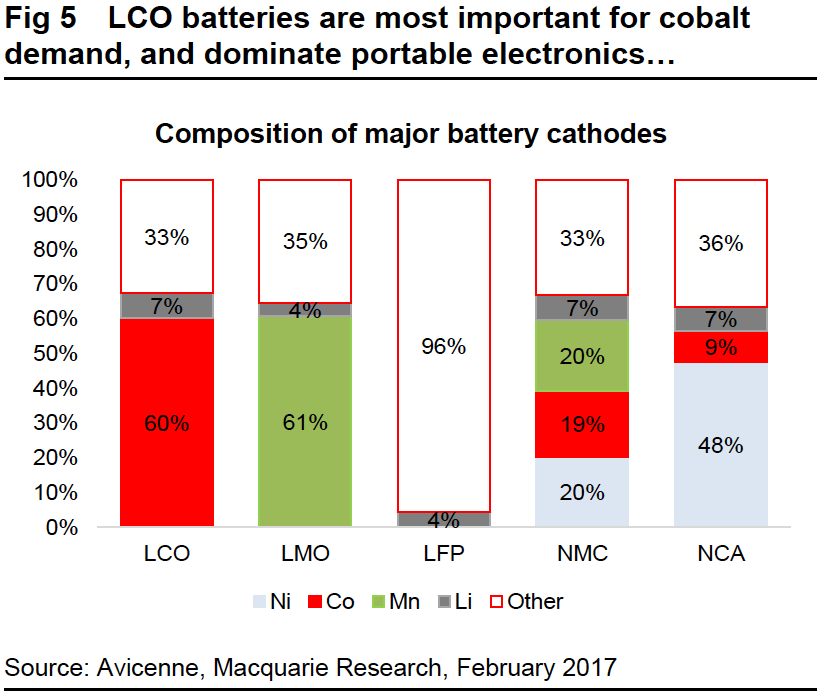
THE SCRAMBLE FOR #COBALT

Image result for cobalt & lithium

The scale and speed of the #Cobalt price surge over the last few months reflects a scramble for units.

#Lithium was the super-hot metals story of 2016. A spectacular price rally propelled lithium out of the metallic shadows onto the global investment stage.

This year it is the turn of #Cobalt.

The price of cobalt traded on the #London Metal Exchange (#LME) has exploded from $33,000 per ton to $55,000 since the start of January.

#Chile’s #Codelco unit seeks value in #Copper impurities, #Arsenic

Image result for modern use of arsenic metal

#Ecometales, a unit of #Chile’s state-run #Codelco, is in talks with smelters in #Europe and #China to share its technology for stabilising #Arsenic while processing lower-quality #Copper ore, an executive said.

Read more at: http://finance.yahoo.com/news/chiles-codelco-unit-seeks-value-134008283.html

New #Graphene based electrode may solve #Solar energy storage challenge

Image result for New graphene based electrode may solve solar energy storage challenge

Inspired by an #American fern, scientists have developed a new #Graphene based electrode that could boost the capacity of existing solar integrable storage technologies by 3,000 per cent. The “groundbreaking” prototype created by researchers from RMIT University in Australia could be the answer to the storage challenge still holding solar back as a total energy solution.

The new electrode is designed to work with supercapacitors, which can charge and discharge power much faster than conventional batteries.Supercapacitors have been combined with solar, but their wider use as a storage solution is restricted because of their limited capacity.

Read more at: http://indianexpress.com/article/technology/science/new-graphene-based-electrode-inspired-from-fern-leaves-to-boost-solar-power-devloped-4596352/


#BBC News: #Graphene-based sieve turns seawater into drinking water

Image result for Graphene-based sieve turns seawater into drinking water

A #UK-based team of researchers has created a #Graphene-based sieve capable of removing salt from seawater.

The sought-after development could aid the millions of people without ready access to clean drinking water.

The promising graphene oxide sieve could be highly efficient at filtering salts, and will now be tested against existing desalination membranes.

Read more at: http://www.bbc.com/news/science-environment-39482342

Liquid metal battery inventor questions #Lithium-ion as grid-scale storage solution

Image result for Liquid metal battery

Grid-scale storage to be feasible, the solution would have to be low cost and have a long service life, which Sadoway asserted was likely to make #Lithium-ion batteries unsuitable in the longer term. “Lithium-ion batteries were developed for portable applications . . . and while they are currently being deployed for large-scale applications, there is no record of the behaviour of these batteries in deep-discharge over long periods of time.”

By contrast, the liquid metal battery draws its inspiration from the large-scale industrial process of #Aluminum smelting, with the Ambri technology conceptualised as a way of holding rather than consuming electricity, as would be the case during the smelting process, and release the electricity on demand.

Read more at: http://www.engineeringnews.co.za/article/liquid-metal-battery-inventor-questions-lithium-ion-as-grid-scale-storage-solution-2017-03-29

#Vale #Indonesia to build $2 billion ferronickel smelter in Southeast #Sulawesi

Image result for Vale Indonesia

Publicly listed #Nickel mine operator PT #Vale #Indonesia plans to build a US$2 billion ferronickel smelter in #Pomalaa, Southeast #Sulawesi.

Read more at: http://www.thejakartapost.com/news/2017/03/29/vale-indonesia-to-build-2-billion-ferronickel-smelter-in-southeast-sulawesi.html

« Older Entries Recent Entries »