Author Archives: Nanthakumar Victor Emmanuel, P.Eng

#Forbes: The Clock May Have Run Out On 1.5 Degrees, But There Are Still Things We Can Do

Carbon-countdown

The climate clock turned red at Berlin’s Mercator Research Institute, signaling that humanity had emitted so much carbon into the atmosphere that it could no longer fend off a 1.5-degree temperature increase without stopping emissions and sucking CO2 back in.

The Mercator Carbon Clock gives humanity 17 years before it exhausts the 2-degree carbon budget.

“We are nowhere close to a 1-degree world. We’re nowhere close to a 1.5-degree world. We’re going to overshoot 2 degrees. If we work like hell we might get 3 degrees, which will be awful.”

We need to control the carbon budget.

It means pursuing any and every kind of carbon policy: tax credits, feed-in tariffs, trading schemes, grants, financing mechanisms, emissions caps, a carbon tax.

It means encouraging carbon use in cement, concrete and fuels or converting CO2 into marketable products like nanotubes, carbon black or carbon monoxide. It means direct air capture. It means reusing CO2 for soda pop.

Read more at: https://www.forbes.com/sites/jeffmcmahon/2018/10/31/the-clock-may-have-run-out-on-1-5-degrees-but-there-are-lots-of-things-we-can-do/#7042d9882d6d


#Princeton University: Call for immediate push for #CO2-removal technology

Carbon-Removal-1_5C-Black-e1508837589745

The escalating effects of climate change now demand a substantial research initiative to develop and launch “negative emissions technologies” (NETs) that remove and sequester carbon dioxide directly from the air, according to a recent report by the National Academies of Sciences, Engineering and Medicine.

Stephen Pacala, Princeton’s Frederick D. Petrie Professor of Ecology and Evolutionary Biology and co-director of the Carbon Mitigation Initiative, chaired the 24-member NAS committee that spent the year researching and writing the report.

According to the report, storing the carbon dioxide from NETs has the same impact on the atmosphere and climate as preventing an equal amount of carbon dioxide from being emitted in the first place. The committee also found that in addition to their effect on mitigating climate change, NETs also could have economic rewards as intellectual property rights and economic benefits will likely accrue to the nations that develop the best technology.

“Negative emissions technologies are essential to offset carbon dioxide emissions that would be difficult to eliminate and should be viewed as a component of the climate change mitigation portfolio,” said Pacala, who was director of the Princeton Environmental Institute (PEI) from 2006 to 2014 and is now a PEI associated faculty member.

Read more at: https://www.princeton.edu/news/2018/10/30/pacala-chairs-national-committee-calling-immediate-push-co2-removal-technology

Water fight raises questions over Chile lithium mining

e9hyHkaRFZdDV_jLZuTS6oMvuTO5GwDl45zgpDP99tW-6igsOcV3IAm96CeaSWeNDXpHXduHdx5MO3wz6V219A

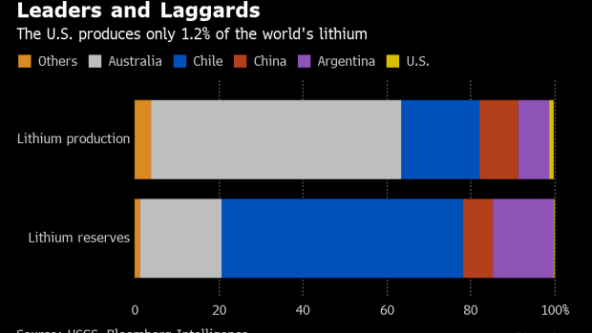
The true state of the #Salar’s water supply, both fresh and saltwater, has become an obsession of #Lithium industry watchers because of the area’s huge importance in satisfying soaring global demand for the powdery white metal. The area is the most cost-efficient place in the world to mine the metal, and both SQM and Albemarle have staked much of their future production on the Salar.


#Chile wants #Lithium to be traded on #LME

top-lithium-producing-countries-2017

#Chile has asked the #London Metals Exchange (#LME) to consider trading the coveted metal used in the batteries that power electric vehicles (EVs) and high-tech devices, and so provide greater “clarity” about its value.

Read more at: http://www.mining.com/chile-wants-lithium-traded-lme/

#Forbes: After A Tough 12 Months #Copper And #Nickel Should Be Next Year’s Metal Winners

8476581-15370001692333872_origin

#Nickel is the only member of the base metal family that also includes aluminium, lead, zinc and tin, to be trading at a higher price this year than at the last #LMW gathering with the positive view of nickel based on demand in its traditional market of stainless steel and its new-found role as a key metal in long-life batteries used in electric cars.

Read more at: https://www.forbes.com/sites/timtreadgold/2018/10/10/after-a-tough-12-months-copper-and-nickel-should-be-next-years-metal-winners/#2bf4673d4d6a

#BBC News: #CO2 Capture – What are these technology solutions?

Stock-1_5C-protest-cop21-1550x804

Climate scientists meeting in #Korea are being urged to avoid relying on untested technologies as a way of keeping global temperature rise under 1.5C.

The Intergovernmental Panel on Climate Change will shortly publish a report on how the world might stay below this limit.

Early drafts said it would require machines to suck carbon out of the air.

The IPCC special report, to be released on Monday, is expected to point towards the use of technology as a critical part of efforts to keep below the guardrail figure.

Earlier versions of the document stated that all the pathways to keeping below 1.5C required rapid reductions in global greenhouse gas emissions with net-zero reached by the middle of this century.

If emissions continue at the present rate, the world would “overshoot” 1.5C by 2040. If this happens, researchers believe that carbon dioxide removal technologies, in some form, would be needed to help bring the Earth’s temperature back down.

The IPCC report is expected to mention a number of approaches that range from planting more trees, to direct air capture of CO2, to bioenergy with carbon capture and storage (BECCS).

The latter involves growing large amounts of plants that capture CO2, and then burning them for energy while capturing and storing the gas that is emitted.

This has long been a controversial approach – requiring huge amounts of land to grow crops for burning. Previous research calculated an area twice the size of India would be needed to help the world stay under 2C of warming this century.

“It sounds crazy, and it is crazy,” said Dr Glen Peters, a climate researcher at the Centre for International Climate and Environmental Research in Oslo, Norway.

“But this may be the only way to keep temperatures well below 2C.

“I struggle to see how the world can remove billions of tonnes of carbon from the atmosphere for decades, but if we want 1.5C then we have to accept that this may be the only possible pathway.”UNFCCC-Pledge-Graph

Read more at: https://www.bbc.com/news/science-environment-45742191

This New #Lithium Battery Tech Can by #MIT Simply Suck Up #CO2 to Power Itself

862-carbon-dioxide-battery-lithium_1024

A team at #MIT has come up with a lithium-based battery system that soaks up carbon dioxide directly from inside power plants, converting the waste steam into a (#CO2-loaded) electrolyte – one of the three main parts of a battery.

#Lithium-carbon-dioxide batteries typically require metal catalysts to function, because carbon dioxide is not very reactive. The problem is, the catalysts can be expensive to source, and the chemical reactions involved can be difficult to control.

To get around this, a team led by mechanical engineer Betar Gallant achieved electrochemical carbon dioxide conversion without the metallic catalyst, using only a carbon electrode.

The answer was to use CO2 in a liquid state, incorporating it into an amine solution.

Read more at: https://www.sciencealert.com/new-lithium-battery-technology-could-soak-up-carbon-dioxide-to-power-itself-co2-ccs-capture-storage-sequestration

The #Californian Rare Earths Mine Caught Between #Trump and #China

-1x-1

The only operating rare earths mine in the U.S. – and once the world’s biggest — is caught up in the crossfire of the #Trump administration’s trade war with #China.

Rare earths, an esoteric group of materials used in everything from #Tesla Inc. automobiles to high-tech military equipment, were dropped this week from the U.S.’s final $200 billion catalog of tariffs on Chinese goods, but China didn’t reciprocate on its own hit list.

“The ten-percent tariffs provide a real challenge, and the prospect of 25 percent is daunting,” James Litinsky, chief executive officer of JHL Capital Group LLC, the majority owner of the Mountain Pass consortium, said by email. “We believe that we can compete without tariffs, and we don’t understand why there would be tariffs on us, when there are no tariffs on #Chinese producers.”

Read more at: https://www.bloomberg.com/news/articles/2018-09-27/the-californian-rare-earths-mine-caught-between-trump-and-china

#Bloomberg: The World’s Leading Electric-Car Visionary Isn’t #ElonMusk

1400x-1

Two decades earlier, #WanGang persuaded #China’s State Council to throw its vast power behind the risky, unproven technology of electric cars. He advocated using government money, including subsidies, to help create a world champion industry that would surpass Western automakers. That coupe he was admiring at the April auto show? It was built by homegrown NIO Inc.

#ElonMusk made a name for himself promoting new-energy vehicles, but when the history of the electric car is finally written, #Wan may loom larger. #Chinese drivers buy one of every two #EVs sold, and the global auto industry is pivoting to adjust. It’s a revolution fomented by #Wan, a former minister of science and technology whose achievements are even more extraordinary when you consider that he never joined the Chinese Communist Party.

Read more at: https://www.bloomberg.com/news/features/2018-09-26/world-s-electric-car-visionary-isn-t-musk-it-s-china-s-wan-gang

Chemists at #DOE – #ORNLdemonstrate sustainable approach to carbon dioxide capture from air

Chemists at the Department of Energy’s (#DOE) Oak Ridge National Laboratory (#ORNL) have demonstrated a practical, energy-efficient method of capturing carbon dioxide (CO2) directly from air. If deployed at large scale and coupled to geologic storage, the technique may bolster the portfolio of responses to global climate change.

For the recent ORNL study, Williams and Flavien Brethomé mixed amino acids with water to make an aqueous sorbent to grab CO2 from air. Amino acids are safer than caustic sodium or potassium hydroxides or smelly amines, the sorbents used in industrial CO2 scrubbers.

The scientists put their aqueous sorbent in a household humidifier to maximize contact between air and sorbent and thus speed CO2 uptake. Once absorbed into the liquid, the CO2 formed a bicarbonate salt.

Read more at: https://www.ornl.gov/news/chemists-demonstrate-sustainable-approach-carbon-dioxide-capture-air

« Older Entries Recent Entries »