Tag Archives: Vale

Innovative #Carbon Injection Pilot Achieves Success – #Canadian #Nickel Mining

A landscape featuring a CO2 injection well and monitoring wells used in Canadian nickel mining, with flags of Canada and the USA in the background.

In-situ carbon injection pilot successfully sequesters 12 tonnes of CO2 at the Crawford Nickel Project.

This initiative operates independently of Canada Nickel’s In-Process Tailings (IPT) Carbonation and NetCarb Programs, marking a significant advancement in the company’s carbon capture and storage capabilities. The results from this study will inform future post-mining carbon sequestration strategies, reinforcing Canada Nickel’s vision for a Zero-Carbon Industrial Cluster in the Timmins Region.

Conducted in collaboration with the U.S. Department of Energy’s Advanced Research Projects Agency – Energy (DOE ARPA-E) funded team, led by Dr. Estibalitz Ukar from the University of Texas at Austin, the pilot project involved nearly two years of planning, laboratory experiments, and the deployment of an extensive monitoring network. The CO₂ injection field test took place from mid-November to mid-December 2025, with all data indicating a successful operation. Approximately 12 tonnes of injected CO₂ remained dissolved at depth, with no surface leakage detected.

The pilot project initiated short-duration injection trials starting on November 20, 2025, over a 12-day period, followed by continuous CO2-saturated water injection from December 2nd to December 18th. The injection well, drilled to a depth of 396m, confirmed that the injected CO₂ remained fully dissolved within the water column, with no upward migration observed.

The water used for dissolving carbon dioxide was sourced from an onsite well, and the well configuration included an injection well, a water supply well, four water monitoring wells, 12 surface seismic monitoring stations, and three seismic monitoring boreholes. Continuous monitoring for seismicity and potential CO₂ gas leakage revealed no significant seismic events and no CO₂ emerging from monitoring wells or through the sedimentary cover. Preliminary chemical analyses suggest that the injected CO₂-rich water has not reached the monitoring wells, aligning with predictions from reactive transport modeling. The absence of surface leakage strongly indicates that all the injected CO₂ remained at depth.

#Bloomberg: #Nickel Gains as #Indonesia Moves to Slash Output at Biggest Mine

Excavators and dump trucks at a nickel laterite ore mining site in Indonesia, with workers in safety gear overseeing the operation.

Indonesia has been taking drastic steps to boost prices of its biggest export commodity, largely through scaling back volumes that key miners are allowed to produce. Before the latest round of cutbacks, supply from the country had risen to about two-thirds of global production, creating a surplus.

The country will issue production quotas of between 260 million and 270 million tons of nickel ore this year, Director General of Minerals and Coal Tri Winarno said. That’s slightly above a previous estimate of 250 million to 260 million tons, but well below the 379 million tons targeted in 2025.

Though higher than the earlier estimate, volumes below 270 million tons are still seen as bullish for prices, said Fan Jianyuan, an analyst with Shanghai-based consultancy Mysteel Global, adding that quota issuance should be completed by March.

Read more at: https://www.bloomberg.com/news/articles/2026-02-11/nickel-extends-gains-as-indonesia-reaffirms-sharp-mining-cuts

#Bloomberg: #Congo to Enforce Local Ownership Rule for #Copper, #Cobalt Miners

Democratic Republic of Congo will enforce a long-dormant rule requiring local employee ownership for mines in a move that may rebalance shareholdings in some of the world’s biggest copper and cobalt producers.

In a letter dated Jan. 30 and addressed to miners of all metals in the country, Mines Minister Louis Watum said firms must demonstrate that 5% of their share capital is held by Congolese employees.

The decision could affect multiple industrial mining projects in the central African nation, which provides about 70% of cobalt supply and is the second-largest copper producer. Glencore Plc, CMOC Group Ltd., Ivanhoe Mines Ltd., Eurasian Resources Group and Zijin Mining Group Co. are among the country’s biggest miners. Barrick Mining Corp. operates one of Africa’s largest gold mines in the country, which also has vast deposits of lithium, tantalum, tin and zinc.

The move comes amid ongoing negotiations between the Trump administration and Congo that could see more US companies invest in the country’s mining industry, which has previously been dominated by Chinese enterprises.

Read more at: https://www.bloomberg.com/news/articles/2026-02-09/congo-to-enforce-local-ownership-rule-for-copper-cobalt-miners

#Burundi Courts #UAE For Areas Of Cooperation

Two leaders shaking hands in a formal meeting setting, surrounded by mineral samples and renewable energy visuals, with flags of Burundi and the UAE displayed.

President Evariste Ndayishimiye of Burundi has launched an ambitious move seeking enhanced cooperation with the United Arab Emirates.

During the World Governments Summit, Gen. Ndayishimiye was received by the President of the United Arab Emirates, HE Mohammed bin Zayed Al Nahyan.

“They discussed issues of diplomatic and economic cooperation within a win-win partnership,” Burundi presidency said shortly after.

A highly isolated Burundi with it’s entire western frontier closed off due to frozen relations with Rwanda since 2015 and an ongoing war in DRC, Ndayishimiye badly needs to look beyond the border for new friends.

Burundi is considering securing investments into the country’s critical minerals sector.

Burundi’s critical mineral resources, particularly its rare earth elements, niobium, and tantalum, are positioned to play a significant role in the global energy transition.

These minerals are crucial for the production of renewable energy technologies, including solar panels, wind turbines, and energy storage systems.

Burundi’s rare earths and nickel deposits, still underexplored, have the potential to attract international investment and boost the country’s role in the mineral supply chain.

Read more at: https://taarifa.rw/index.php/2026/02/07/burundi-courts-uae-for-areas-of-cooperation/

#China’s #Nickel black hole in #Indonesia

Aerial view of an industrial site with smoke rising from chimneys, featuring large machinery, conveyor belts, and flags of China and Indonesia prominently displayed.

Over the past decade, Indonesia has become the world’s largest processor of nickel, driven in large part by Chinese investment. Industrial estates expanded rapidly in Sulawesi and eastern Indonesia, driving an export boom. Indonesia moved closer to its goal of capturing more value from its mineral resources rather than exporting raw ore.

This outcome followed deliberate policy choices. Jakarta banned the export of unprocessed nickel, expedited permit approvals and promoted downstream processing as a national priority. Chinese firms responded with capital, engineering capacity and speed. The arrangement aligned mutual interests and reshaped global nickel supply.

This scale of investment now underscores the urgent need for robust governance to protect national interests.

Failure to enforce a core reporting obligation for years reveals a critical regulatory gap. If rules are not followed, institutional oversight breaks down and Indonesia’s authority over its strategic nickel sector is weakened.

The environmental implications are immediate. Nickel processing is energy-intensive and often relies on coal. Industrial expansion can increase deforestation, water stress, and flood risk if controls weaken. Central Sulawesi has already experienced environmental pressure around industrial zones. Effective monitoring depends on accurate, routine reporting.

Indonesia’s advantage lies not only in its nickel reserves but in its ability to govern them. Natural resources create opportunity; institutions determine outcomes.

The next phase of China-Indonesia economic cooperation will test that capacity. Industrial ambition has delivered rapid gains for Indonesia. Sustaining them will depend on disciplined enforcement, clear data and consistent oversight.

Read more at: https://asiatimes.com/2026/02/no-reports-no-records-chinas-nickel-black-hole-in-indonesia/

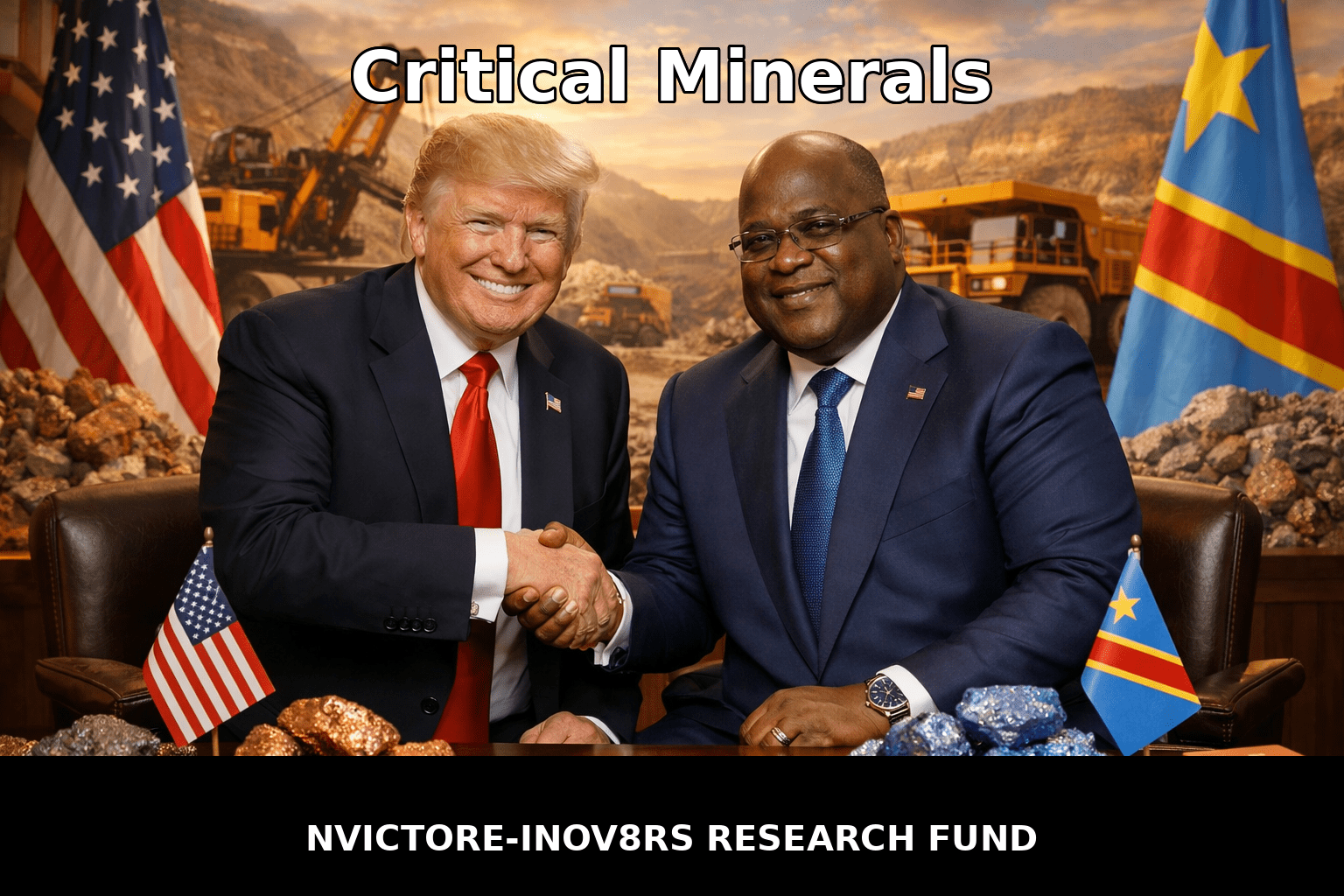
#US pushes for bigger slice of #Congo’s mineral resources

Former President Donald Trump shakes hands with an official from the Democratic Republic of the Congo, in front of a backdrop featuring mining imagery, with text reading 'Critical Minerals'.

U.S. President Donald Trump is rolling out the red carpet for Congo’s President Félix Tshisekedi this week, positioning the war-ravaged African country as a central pillar in his plan to expand U.S. ownership of critical minerals.

The Democratic Republic of the Congo is a major producer of copper and cobalt – two of the critical minerals that Mr. Trump is targeting for U.S. acquisitions.

A commercial deal to ensure U.S. access to Congo’s mineral resources was attached to the U.S.-led peace process between Congo and Rwanda this year. The agreement is the biggest mineral deal in U.S.-Africa history, Mr. Trump told a prayer-breakfast audience in Washington on Thursday.

China controls an estimated 70 to 80 per cent of copper and cobalt mining in Congo, but Mr. Trump seems determined to break into the sector in a big way.

Read more at: https://www.theglobeandmail.com/business/article-us-pushes-for-bigger-slice-of-congos-mineral-resources/

#CNBC: #US plans #CriticalMineral price floors with #Mexico, #EU and #Japan

The United States is developing plans with Mexico, the European Union and Japan to implement minimum prices for critical minerals, the U.S. trade representative said Wednesday.

The Trump administration is exploring a partnership with Mexico on critical minerals as part of a scheduled review of the United States-Mexico-Canada trade agreement, or USMCA, by July 1.

The U.S. and Mexico will explore ways to implement price floors for critical mineral imports, and will discuss how to implement those minimum prices in agreements with other nations, an official in the trade representative’s office said.

The Trump administration has put critical minerals at the center of its trade and industrial policies in an effort to reduce dependence on China. Beijing dominates the global supply chain and tried to cut off exports of rare earths, a subset of the minerals that are used in everything from munitions to consumer electronics, during trade disputes with the U.S. last year.

Read more at: https://www.cnbc.com/2026/02/04/us-plans-critical-mineral-price-floors-with-mexico-eu-and-japan.html

#CriticalMminerals: licensing, tariffs, and the new supply-chain risk

Graphic illustrating US government support for local critical mineral refineries, featuring lithium batteries, a modern electric car, a laptop, and industrial workers in a refinery setting. Text highlights federal funding and initiatives for research and domestic processing.

Critical minerals are no longer just industrial inputs. They are now strategic assets treated by governments as both economic infrastructure and national security leverage. Critical minerals sit inside everyday objects like smartphones, hairdryers, vacuums, and electric vehicles, but also inside missile guidance systems and power grids.

U.S. law reflects that broadened view. The Energy Act of 2020 defines “critical minerals” as minerals or materials that are essential to U.S. economic or national security, have supply chains vulnerable to disruption, and perform an essential manufacturing function such as that their absence would carry significant consequences.

In practice, that definition is sweeping. anchor battery supply chains. Gallium and germanium support semiconductors and other high-tech uses. Rare earth elements such as neodymium and dysprosium underpin permanent magnets found in electric vehicles, wind turbines, and defense applications.

As companies diversify away from concentrated suppliers, a second-order risk emerges. Some alternative sources sit in higher-risk jurisdictions, where governance, labor, or conflict-linked concerns are more acute.

This is where “critical minerals” and “conflict minerals” begin to overlap in practice. Even when the commodity is available, shipments can be disrupted by forced-labor enforcement, sanctions exposure, or traceability requirements imposed by customers, regulators, or financiers. A sourcing shift meant to reduce geopolitical risk can accidentally import compliance risk.

What this means for companies

For importers, manufacturers, and downstream buyers, the near-term imperative is operational. It is to build a compliance-and-procurement posture that assumes volatility.

Practical steps include:

Map exposure: Identify where critical minerals enter production, either directly or embedded through subcomponents.

Classify and document early: For controlled inputs, assume licensing and end-use information will be required, and build documentation upstream with suppliers.

Contract for delay: Treat licensing and customs holds as foreseeable risks and allocate them clearly in contracts.

Diversify with diligence: Diversification plans should include conflict minerals/forced-labor screening and traceability, not just alternate countries of origin.

Monitor policy signals: Lists, proclamations, and export controls notices are increasingly early warning systems for trade risk.

For U.S.-based processors and refiners, the new critical minerals objectives may allow for new opportunities, with the Administration’s focus on domestic capacity expansion creating favorable conditions for investment in U.S.-based processing and refining operations. Companies aligned with U.S. supply-chain security objectives may find enhanced opportunities for partnerships and government support.

Conclusion

Critical minerals have become trade’s hard currency. They are not just priced, but negotiated; not just mined, but regulated; and not just shipped, but screened.

For businesses, the lesson is that in the critical minerals economy, supply chains are no longer merely commercial. They are strategic, and trade policy is being built to match.

Read more at: https://www.reuters.com/legal/legalindustry/critical-minerals-licensing-tariffs-new-supply-chain-risk–pracin-2026-01-29/

#China to Open Up #Nickel and #Lithium Futures to Foreign Investors

A blue BYD electric car and a red Tesla Model S are displayed on a colorful financial background featuring an upward trend in nickel and lithium futures, alongside a Chinese dragon and the Great Wall of China.

China will allow overseas investors to invest in domestic nickel and lithium futures, part of Beijing’s efforts to boost its influence in global commodities markets.

Nickel and lithium carbonate are among 14 futures and options products that will be opened up, the China Securities Regulatory Commission said in a statement on Friday. Exchanges would be urged to make preparations to implement the changes, it said, without providing any start dates. 

China is the world’s largest buyer of raw materials, but benchmark prices are mainly set in financial centers like London, Singapore and New York. Beijing wants more sway over prices, and the move also dovetails with its goal of burnishing the yuan’s appeal as a global currency.

Read more at: https://financialpost.com/pmn/business-pmn/china-to-open-up-nickel-and-lithium-futures-to-foreign-investors

#Africa’s #CriticalMinerals are a huge economic opportunity: #G20 framework sets out ways to seize it

An artistic depiction showcasing critical metals, featuring piles of colorful mineral ores, solar panels, wind turbines, and a white electric car against a backdrop of an outlined African map.

Cobalt, manganese, natural graphite, copper, nickel, lithium, and iron ore are essential inputs for solar panels, wind turbines, electric vehicle batteries, and other clean-energy technologies.

Africa hosts some of the world’s largest reserves of critical minerals, including approximately 55–70% of global cobalt resources, nearly half of known manganese reserves, and more than 20% of natural graphite. The continent also contains around 5–7% of global copper and nickel reserves, smaller but strategically important shares of lithium, and limited iron ore reserves.

South Africa alone holds between 80% and 90% of the world’s platinum group metals, as well as over 70% of global chromium reserves, making it central to clean-energy and industrial supply chains.

According to the International Energy Agency, demand for lithium is expected to increase four- to six-fold by 2040, while demand for graphite and nickel will roughly double or more. Cobalt and rare earth element demand is projected to rise by 50–70%, and copper demand by approximately 30% over the same period.

Read more at: https://www.modernghana.com/news/1466175/africas-critical-minerals-are-a-huge-economic.amp

« Older Entries Recent Entries »