Tag Archives: ev

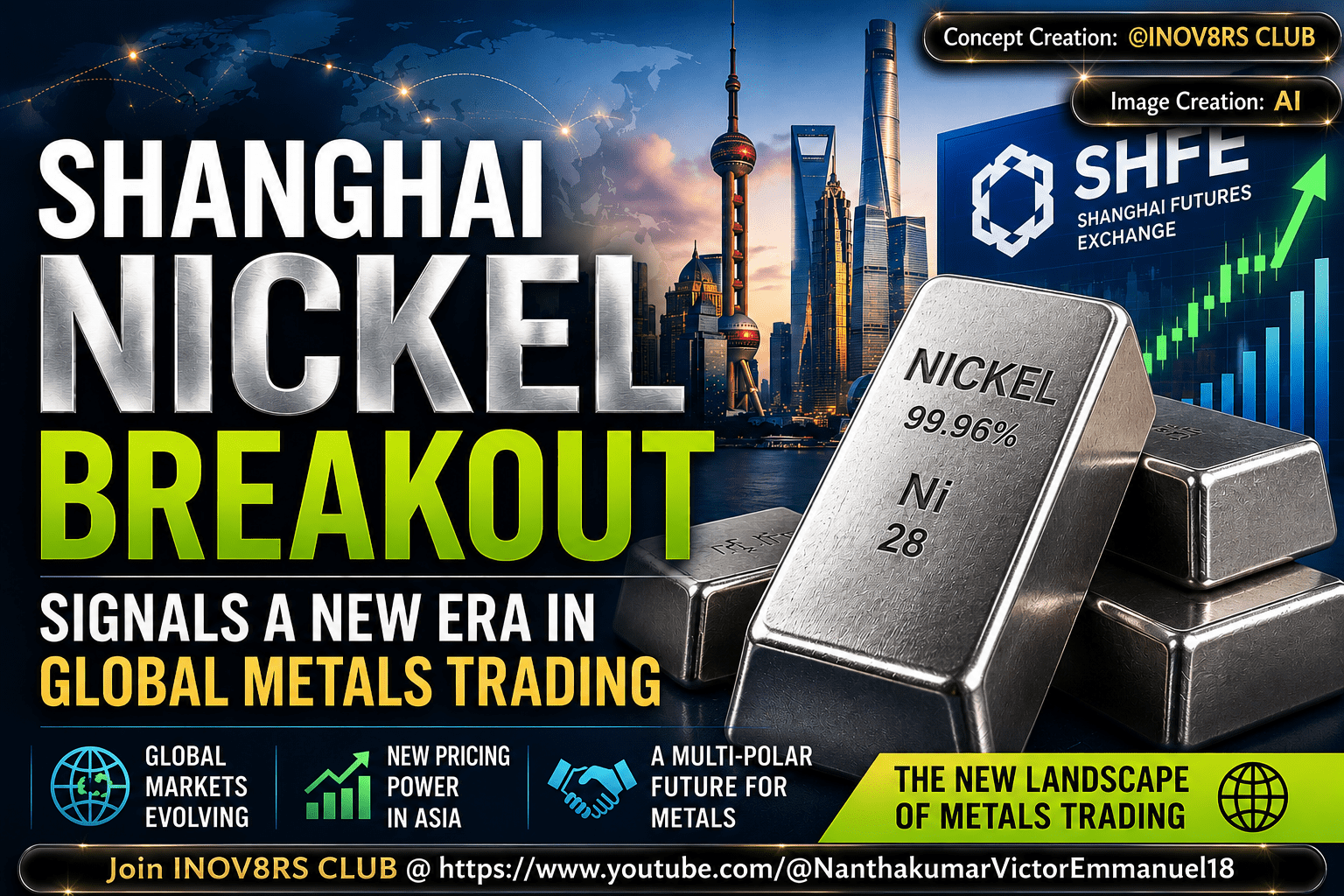
#Shanghai #Nickel Breakout Signals a New Era in Global Metals Trading

Graphic highlighting the Shanghai Nickel Breakout and its impact on global metals trading, featuring nickel ingots, the Shanghai skyline, and text outlining new pricing power in Asia.

The international launch of the Shanghai Futures Exchange’s (ShFE) nickel contract represents more than an expansion of China’s derivatives market—it marks another step in the structural evolution of global metals trading. As supply chains become increasingly regionalized and geopolitical considerations reshape commodity flows, pricing power is gradually shifting from a single global benchmark toward multiple regional centers.

For decades, the London Metal Exchange (LME) has served as the world’s primary benchmark for industrial metals. However, changing production patterns, trade realignments, and China’s growing dominance across the metals value chain are accelerating the development of a more fragmented—but arguably more representative—pricing ecosystem.

Nickel: The Ideal Candidate for Internationalization

Nickel is uniquely positioned to spearhead Shanghai’s international ambitions.

China’s extensive investment in Indonesia has transformed the Southeast Asian nation into the world’s largest nickel producer in just over a decade. The resulting integrated supply chain—from Indonesian mines to Chinese refining facilities and downstream stainless steel and electric vehicle battery manufacturers—has created a regional ecosystem that increasingly operates independently of traditional Western trading hubs.

Opening the ShFE nickel contract to overseas participants aligns financial infrastructure with these physical trade flows. It also strengthens the role of the renminbi in cross-border commodity transactions, an objective that supports Beijing’s broader financial market internationalization strategy.

For producers, consumers, and traders operating within the Asian nickel supply chain, a regional benchmark offers pricing that is increasingly reflective of underlying physical market fundamentals.

From Global Benchmark to Regional Price Discovery

The evolution of metals pricing is no longer a contest between competing exchanges. Instead, it reflects the emergence of complementary regional benchmark systems.

The LME continues to provide the principal international reference price for many industrial metals, particularly in Europe, the Middle East, and Africa. Meanwhile, the CME has strengthened its position in North America, where domestic market dynamics increasingly diverge from international fundamentals. Shanghai is establishing itself as the natural pricing center for Asia, where the majority of global metals production and consumption now occurs.

Rather than replacing London, Shanghai is expanding the global pricing architecture by serving a market that has grown too large and too distinct to rely exclusively on external benchmarks.

Inventory Trends Reveal Structural Market Separation

Warehouse inventory movements provide one of the clearest indicators of this transition.

While nickel inventories on the LME have stabilized, stocks registered with the ShFE continue to build. This divergence suggests that surplus metal is increasingly remaining within Asian storage networks instead of being delivered into London warehouses.

Such inventory behavior reflects deeper structural changes. Regional supply chains are becoming increasingly self-contained, encouraging localized price discovery and reducing dependence on a single global delivery system.

This trend is particularly significant because warehouse inventories remain one of the most visible indicators of physical market balance.

Strategic Collaboration Rather Than Direct Competition

An important feature of the evolving landscape is that exchanges are increasingly pursuing cooperation alongside competition.

The LME’s planned U.S. dollar-denominated futures contract linked to Shanghai’s domestic hot-rolled coil (HRC) steel benchmark illustrates this strategy. China’s steel market is several orders of magnitude larger than international export markets, making domestic pricing highly relevant for global participants.

Connecting Shanghai’s liquidity with London’s international reach enables both exchanges to serve a broader range of market participants while enhancing price transparency across regions.

This model could provide a framework for future cross-listed contracts covering additional industrial metals.

Copper Highlights the Regionalization Trend

Copper markets already demonstrate how regional factors can reshape benchmark pricing.

Trade policy, tariffs, and evolving supply chains have created sustained divergence between U.S. and international copper prices. North American pricing increasingly reflects domestic policy considerations, while the LME continues to capture broader global fundamentals.

Should Shanghai eventually internationalize its copper contract, the market could transition toward three distinct regional pricing centers, each reflecting different supply-demand dynamics and policy environments.

Such a development would fundamentally redefine global price discovery for the world’s most economically significant industrial metal.

Rising Volumes Across Major Exchanges

Contrary to expectations, the emergence of multiple benchmark centers has not fragmented market liquidity.

Trading activity has expanded across the LME, ShFE, and CME, reflecting greater participation from industrial hedgers, institutional investors, proprietary trading firms, and retail market participants.

This suggests that regional specialization is enlarging the overall derivatives ecosystem rather than redistributing a fixed volume of activity. Greater opportunities for regional arbitrage, basis trading, and cross-market hedging are generating additional liquidity across all major exchanges.

The growth of smaller contract formats and new options products further demonstrates the industry’s ability to attract new categories of market participants without reducing activity in established benchmark contracts.

Outlook

Shanghai’s international nickel contract should be viewed as an early indicator of a broader structural transition rather than an isolated product launch.

Global metals markets are evolving toward a multi-polar trading framework in which London, Shanghai, and Chicago each perform distinct but complementary roles. Physical supply chains are becoming increasingly regional, and financial markets are adapting accordingly through localized benchmarks, expanded derivatives offerings, and greater cross-border participation.

For producers, consumers, investors, and commodity traders, the implication is clear: successful market analysis will increasingly require monitoring multiple benchmark systems rather than relying on a single global reference price.

The future of metals trading is unlikely to be defined by one dominant exchange. Instead, it will be characterized by interconnected regional markets that collectively reflect the increasingly complex geography of global commodity production, consumption, and trade.

Source: Reuters

#China’s breakthrough in solid-state battery technology – double the energy density on a 3-minute charge

A laboratory setup featuring a cross-section view of a battery cell with labeled components including lithium metal, solid electrolyte argyrodite separator, aluminum foil, copper foil, and NMC cathode. In the background, a researcher is working at a microscope with various scientific instruments and notes visible on the table.

Researchers are continually attempting to advance the technology behind solid-state batteries, and China seems to be leading the charge. Following a breakthrough that packs more energy into the same size battery, researchers from the Chinese Academy of Sciences may have developed a powerful new solid-state battery that provides impressive energy density, can be charged ultra-fast, and overcomes common concerns with this battery type. As its name suggests, solid-state batteries leverage solid electrolytes, or materials, to conduct ions between electrodes, versus the liquid or gel polymer materials used in conventional batteries, potentially offering improved performance and safety.

The team reports a solid-state lithium-metal battery with a density of 451.5 watt-hours per kilogram, which is more than double what commercial lithium iron phosphate EV battery cells can achieve. Moreover, it maintained “stable cycling” for 700 cycles with an 81.9 percent capacity retention. In other words, it’s powerful enough to hold a significant charge, can be replenished ultra-fast in three-minute sessions, and maintains its power capacity over many cycles. According to the researchers, they achieved this with a “compatibilizing-solvent plasticization” strategy that introduces a solvent to improve compatibility between the polymer and stable plasticizers.

The researchers basically stabilized and strengthened the electrolytes

The study suggests that “conventional plasticizers” used in PVDF electrolytes — a type of polymer used in advanced batteries — has poor electrochemical instability. Using the “compatibilizing-solvent plasticization” strategy the researchers essentially create a film — a lithium-fluoride-rich interfacial layer — that keeps the plasticizers locked into the polymer network. They use a temporary volatile solvent, acetone, to boost compatibility, which evaporates during the film’s formation. This discovery could lead to more practical designs of lithium-metal batteries that exhibit the high energy density, for more power storage, and fast-charging support demonstrated in the study. That would have huge implications for EV technologies, vastly improving their overall range.

Although research has advanced in recent years — solid-state battery power banks are already here — they still pose quite a few challenges. Dense solid-state batteries are plagued by high-current metallic cracks called dendrites, which cause short circuiting or worse. So while there’s still advancements to be made with solid-state batteries, it’s easy to see that battery technology research is moving at a good pace. China’s new all-iron battery might beat lithium options at a fraction of the cost, while nuclear batteries could change everything we know about portable power, if they come to pass.