Tag Archives: Australia

#AI’s Information Reverse Paradox: How Company Secrets, Know-How & Patent Rights Are at Risk

When Company Secrets Become Public Knowledge

Most organizations understand that confidential documents should never be posted on the public internet. Yet the AI era introduces a subtler risk: valuable know-how can gradually escape through routine interactions with AI systems.

Every day, employees ask AI to:

  • Refine proprietary algorithms
  • Optimize manufacturing processes
  • Analyze customer behavior
  • Improve pricing strategies
  • Draft patent applications
  • Review source code
  • Summarize confidential research

Each prompt may reveal only a small piece of information. However, over months or years, these interactions can expose an organization’s unique methods, terminology, workflows, and decision-making patterns.

Even when AI providers state that enterprise customer data is isolated or not used for public model training under specific contracts, organizations must still carefully manage what information they share. Internal deployments, third-party integrations, misconfigured systems, or future changes in data governance policies can all introduce unexpected risks. The safest approach is to treat proprietary know-how as a strategic asset and establish clear governance over how AI systems are used.

Know-How: The Intellectual Property That Patents Can’t Fully Protect

When discussing intellectual property, patents often receive the most attention. Yet for many businesses, know-how is even more valuable.

Know-how includes:

  • Manufacturing techniques
  • Process optimization
  • Internal operating procedures
  • Supplier relationships
  • Customer engagement strategies
  • Quality control methods
  • Engineering experience
  • Lessons learned over years of experimentation

Unlike patents, know-how frequently derives its value from remaining confidential. Once widely disclosed, much of its competitive advantage may disappear.

Consider the formula for Coca-Cola, semiconductor fabrication techniques, or highly optimized industrial production methods. Their value lies not only in invention but also in the accumulated experience required to reproduce them consistently.

AI creates a new challenge because employees may unknowingly disclose fragments of this institutional knowledge while seeking productivity gains.

Patents Protect Inventions—Not Competitive Advantage

Patents provide inventors with exclusive rights for a limited period, but they require public disclosure. In exchange for protection, inventors must explain their invention sufficiently for others skilled in the field to understand it.

This trade-off has worked well for centuries because the patent system encourages innovation while eventually enriching the public domain.

However, many competitive advantages are intentionally never patented.

Companies often choose trade secret protection when:

  • Reverse engineering is difficult.
  • The innovation can remain confidential.
  • The commercial value may outlast the life of a patent.
  • The competitive edge lies in operational expertise rather than a single invention.

The danger in the AI era is that organizations may inadvertently weaken this trade secret protection by embedding confidential methods, prompts, workflows, or engineering knowledge into AI interactions without fully understanding where that information is stored, processed, or retained.

The Public Domain Effect

Knowledge naturally migrates toward the public domain over time through publications, patents, employee mobility, academic research, and market competition.

AI has the potential to accelerate this process.

As organizations increasingly rely on AI to solve technical problems, summarize internal documents, or generate software, a growing portion of proprietary expertise risks becoming encoded into broader AI-assisted workflows. While enterprise AI providers implement contractual and technical safeguards, the cumulative effect of widespread AI adoption is that unique organizational know-how may become easier to replicate across industries.

This does not necessarily mean that confidential information becomes publicly accessible. Rather, the uniqueness of proprietary expertise may gradually erode as AI systems help disseminate similar best practices, design patterns, and problem-solving approaches across many organizations.

The result is a shift in competitive advantage: companies may need to innovate continuously rather than relying solely on accumulated institutional knowledge.

Governance Is Becoming an Intellectual Property Strategy

Historically, intellectual property strategy focused on deciding whether to patent an invention or keep it as a trade secret.

Today, organizations face a third question:

What should employees be allowed to teach AI?

Answering this requires more than cybersecurity policies. It calls for AI governance frameworks that define:

  • Which information can be shared with external AI systems.
  • Which AI platforms are approved for sensitive work.
  • How prompts and outputs are logged and audited.
  • When private or on-premises AI models are required.
  • How trade secrets and know-how are preserved while still enabling AI-driven productivity.

In the AI economy, protecting institutional knowledge may become as important as protecting the inventions themselves.

Quad members (#US, #Japan, #Australia and #India) unveil $20bn #CriticalMinerals initiative

A visually engaging graphic depicting the planet Earth with highlighted continents, featuring the flags of India, Japan, the United States, and Australia. The design emphasizes connections between these countries, labeled 'Critical Minerals QUAD Members,' with glowing effects and illustrations of network lines.

The US, Japan, Australia and India have unveiled a $20 billion framework to strengthen critical minerals supplies as Washington continues to seek ways to loosen China’s stronghold.

The four Quad partners said they intend to raise up to $20 billion in public and private sector support to boost critical minerals supply chains that includes mining, processing and recycling by identifying projects in member countries.

“Through the Quad Critical Minerals Initiative, Quad partners intend to work together to use economic policy tools and co-ordinated investment to accelerate the development of diversified and fair critical mineral markets. and support the supply of critical minerals that are crucial to our region’s economic growth and security,” the members said in a statement.e 

Monday’s announcement followed US Secretary of State Marco Rubio’s visit to India, where he and Quad foreign ministers also announced initiatives to strengthen maritime and transnational security, emerging technology and humanitarian assistance.

Under the critical minerals agreement, the Quad partners said they would support strategic projects through export credit agencies, private capital, development financial institutions, and explore new ways to raise private capital in the critical minerals space.

Critical minerals are used to produce advanced technology, defence systems, electric vehicles and other technologies in the clean energy transition.

Read more at: The National News

#Australia-#Japan Joint Statement on Elevated #CriticalMinerals Cooperation

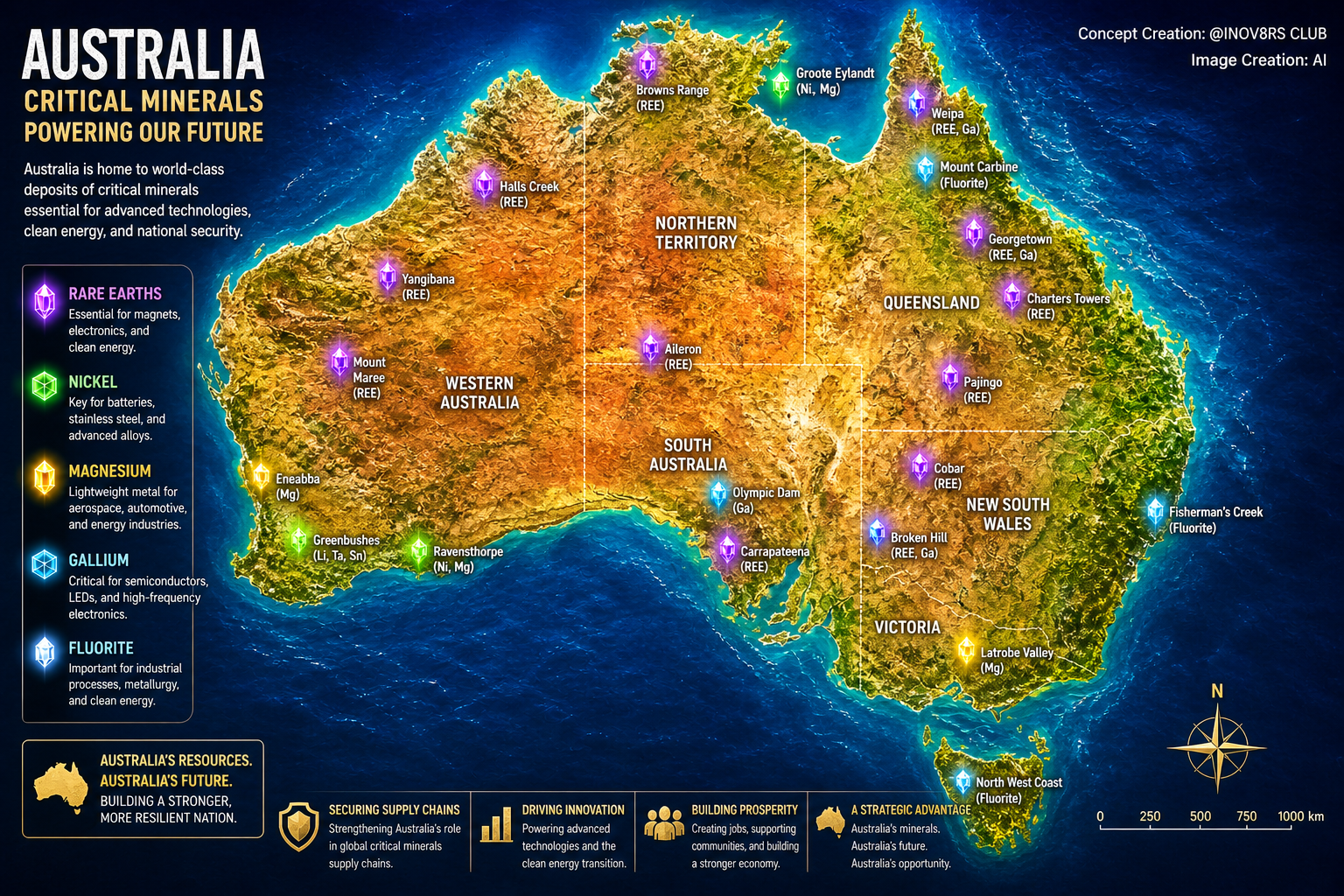
Map of Australia highlighting major regions rich in critical minerals essential for technology, clean energy, and national security. Locations include deposits of rare earths, nickel, magnesium, gallium, and fluorite across various states.

The two Governments have already identified the following key projects that have the potential to materially diversify the supply chains for critical minerals:

  • Lynas Rare Earths Project
    A flagship initiative symbolising collaboration between Japanese and Australian industry on critical minerals. In 2011, a joint venture (JARE) between Sojitz Corporation and JOGMEC provided equity and loan financing to Lynas Rare Earths to commence light rare earth production. In 2025, the project reached a further milestone with the commencement of heavy rare earth production.
  • Alcoa Gallium Recovery Project
    This project involves Alcoa working with Japan Australia Gallium Associates (JAGA)—a joint venture between Sojitz and JOGMEC—to develop gallium recovery at one of Alcoa’s operating alumina refineries in Western Australia, for use in semiconductors, LEDs, and solar cells. The project is planning to be supported by equity investment from the Governments of Japan, Australia, and the United States.
  • Magnium Magnesium Project
    Magnium Australia is planning the commercial production of high‑purity magnesium, widely used in lightweight applications including the automotive and aerospace sectors, in Western Australia using a low‑carbon process with reduced environmental impact. Hanwa Co. Ltd., a Japanese trading company, as well as the Government of Japan, has also expressed interest in this initiative.
  • Tivan Fluorite Project
    The Speewah Fluorite Project, located in Western Australia, is a Japanese Government‑supported initiative involving a joint venture between Sumitomo Corporation and JOGMEC, in collaboration with Tivan Limited, to produce acid‑grade fluorite, a key raw material for hydrofluoric acid used in semiconductors, EVs, and other advanced applications. It has also received a non-binding and conditional Letter of Support from EFA.
  • RZ Resources Critical Minerals Project
    The Copi Critical Minerals Project in New South Wales is a mineral sands project, looking to develop supply of critical minerals and rare earth elements, owned by RZ Resources, with participation from JX Metals Corporation and Marubeni Corporation. It has also received non-binding indications of support as a critical minerals project from EFA and the U.S. Export Import Bank.
  • Ardea Resources Kalgoorlie Nickel Project
    The Kalgoorlie Nickel Project – Goongarrie Hub is one of the largest nickel cobalt resources in Australia. The project is being developed as a joint venture with Ardea Resources, Sumitomo Metal Mining, and Mitsubishi Corporation. The Government of Japan has provided funding support under its economic security grant towards building a resilient and secure critical minerals supply chain. The project has received non-binding and conditional indications of support from EFA and the U.S. Export Import Bank. The Australian Government has selected Ardea to participate in its investor front door pilot, which aims to streamline project engagement with government.

Read more at: Department of the Prime Minister and Cabinet

#Australia and #US double #CriticalMinerals funding

Illustration of the Pacific mineral supply chain depicting mining sites, refining and processing, manufacturing, and global trade routes, featuring Australian elements and critical minerals like nickel.

A record boost in bilateral minerals funding

Australia and the United States have committed over A$5 billion ($3.5 billion) to critical mineral projects, almost doubling the amount pledged when their cooperation framework was established six months ago. The funding will be delivered via Export Finance Australia and the U.S. Export-Import Bank, focusing on projects that strengthen strategic industries. Canberra says this positions Australia as a global leader in diversifying supply chains for rare earths and other critical minerals.

Future scenarios for the minerals alliance

If the funding accelerates project timelines and scales production, Australia could emerge as a key non-Chinese processing hub, reshaping global supply dynamics and reducing market vulnerability. Alternatively, delays from environmental, technical, or market challenges could limit impact, leaving Western nations exposed to existing dependencies. Both scenarios will influence the pace of the energy transition and the resilience of high-tech manufacturing supply chains.

Read more at: MSN

How are China and Iran cornering US without firing a shot amid tensions in Gulf – The Times of India

Ardea – Western #Australian #Nickel project grabs #Japanese – #US attention

A silhouette of Australia filled with an industrial landscape featuring mining activity, overlaid with the flags of the United Kingdom, United States, and Japan, symbolizing international relationships.

Ardea Resources’ Kalgoorlie nickel project (KNP) has received a shout-out in the Japan-US Critical Minerals Joint Fact Sheet, a call-to-action to shore up critical mineral supply chains between the two powerful nations and other Western markets.

The company’s nickel-cobalt project, about 70 kilometres north of the city of Kalgoorlie-Boulder in Western Australia, comprises its bulk-scale KNP – Goongarrie Hub and hosts a mammoth 854 million tonnes grading 0.71 per cent nickel and 0.045 per cent cobalt for a whopping 6.1 million tonnes of contained nickel and 386,000 tonnes of cobalt.Ardea Resources’ Kalgoorlie nickel project (KNP) has received a shout-out in the Japan-US Critical Minerals Joint Fact Sheet, a call-to-action to shore up critical mineral supply chains between the two powerful nations and other Western markets.

The company’s nickel-cobalt project, about 70 kilometres north of the city of Kalgoorlie-Boulder in Western Australia, comprises its bulk-scale KNP – Goongarrie Hub and hosts a mammoth 854 million tonnes grading 0.71 per cent nickel and 0.045 per cent cobalt for a whopping 6.1 million tonnes of contained nickel and 386,000 tonnes of cobalt.

Read more at: https://www.smh.com.au/business/companies/ardea-wa-nickel-project-grabs-japanese-us-attention-20260323-p5rupb.html

#RBC: Bridging #Canada’s #CriticalMinerals Capital Gap

An image of a map of Canada filled with various colorful minerals and rocks, showcasing a Canadian flag and the logo of RBC, accompanied by the title 'Mine & Refine: Bridging Canada’s Critical Minerals Capital Gap'.

Capital is needed for Canada to take advantage of the critical minerals industry that’s projected to grow between two to three times globally with a capital requirement of US$500-600 billion by 2040, according to an International Energy Agency forecast. Global demand for six core commodities—cobalt, copper, graphite, lithium, nickel and rare earth elements—will be driven by several growth sectors, including electric vehicles, clean energy infrastructure and space. As well as strategic sectors such as defence, manufacturing and electronics.

Canada holds world-class geology across all six metals but remains a relatively marginal player, accounting for roughly 2% of the global supply of the six metals. If identified projects proceed at full capacity, it could climb to 14% of total supply over the next 15 years, on average, according to Canadian government estimates. The development of vertical supply chains such as an expanded advanced manufacturing base, could have an exponential impact on Canadian supply to meet domestic and international demand.

Yet, Canada remains largely a “mine-and-ship” jurisdiction. Raw metals are shipped mostly to China where they are refined and transformed into high-value components. It’s the result of two decades of capital allocation decisions and the lack of a robust national strategy, but also China’s ability to depress metal prices to crush competitors.

There’s considerable global momentum to propel the Canadian critical minerals industry forward. The U.S. is leveraging its funding, market mechanisms and guarantees to build out a critical minerals market that excludes China. Meanwhile, Europe and several G20 allies are eager to diversify their critical minerals supply chain as they fear the Chinese industrial machine will crush their domestic economies and leave them ever more beholden to Beijing.

China’s recent export controls on key minerals—including rare earths, graphite, gallium, germanium—over the past year are a clarion call for Western countries to act.

Among its G7 allies, Canada is best equipped to take advantage: it’s home to high-grade lithium belts and graphite deposits in Quebec and Ontario, globally significant nickel resources in Manitoba, formidable copper reserves in British Columbia, and rare earth elements in pockets across Canada, including Newfoundland and Labrador. Few countries can claim this breadth across all six critical minerals at scale.

Closing the gap requires a coordinated public-private agenda anchored in sovereign co-investment, infrastructure financing, miner-driven shared processing corridors and integration into Western supply chains.

Read more at: https://www.rbc.com/en/thought-leadership/climate-action-institute/energy-reports/mine-refine-bridging-canadas-critical-minerals-capital-gap-2/

#US Agencies Have Developed #CriticalMinerals Price Floor System

An image representing critical minerals with an upward growth graph, rocks, and battery cans, featuring flags of the USA, Canada, the UK, Australia, and the EU in the background.

The US has developed a critical minerals price floor system that it’s pitching to allies as the Trump administration and more than 50 countries look to reduce dependence on China for the resources that are deemed critical to national security.

Under Secretary of State for Economic Affairs Jacob Helberg said multiple US agencies have developed the system and are having conversations with allies and partners. It’s the latest update to progress being made by the US and its allies to ringfence Western companies from China’s pressure on those markets.

Read more at: https://www.bloomberg.com/news/articles/2026-02-17/us-agencies-have-developed-critical-minerals-price-floor-system

#India reaches out to critical mineral producers for processing technology

NEW DELHI: India has reached out to key critical mineral producers to bring in processing technology into the country, officials said. The move comes close on the back of the government rolling out auctions of critical mineral mines.

“Talks are on with the United States (US), Australia, and United Kingdom (UK), South Korea, and Japan for processing technology. Brazil and Argentina are also positive about collaborating with India,” a senior mines ministry official told ET.
According to another official aware of the plan, agreements with countries are being lined up and will soon be signed.

While India is going ahead with auction of mines holding critical minerals, there are no facilities for their beneficiation.

“We want to target India’s first critical mineral beneficiation and processing plant in the next 3-5 years,” the official quoted above said. “We want to ensure that development of critical mineral processing and extraction happen in parallel.”

Read more at: https://economictimes.indiatimes.com/industry/indl-goods/svs/metals-mining/india-reaches-out-to-critical-mineral-producers-for-processing-technology/articleshow/108924719.cms?from=mdr

Mining, wind contracts signed in China

Mining and wind farm deals valued at more than $3 billion have been signed in Beijing during Prime Minister Julia Gillard’s visit on Tuesday.

http://www.skynews.com.au/businessnews/article.aspx?id=862004


BHP Says Alumina, Nickel Units Pressured, Spurring Sale Talk

BHP Billiton Ltd. (BHP), the world’s biggest mining company, said the high Australian dollar and weak prices are hurting its local alumina and nickel operations, spurring speculation of possible writedowns or asset sales.

http://www.bloomberg.com/news/2013-01-23/bhp-says-alumina-nickel-units-pressured-spurring-sale-talk.html

« Older Entries