Tag Archives: Technology

#China’s #RareEarth Policy: Driving Innovation and Competitiveness
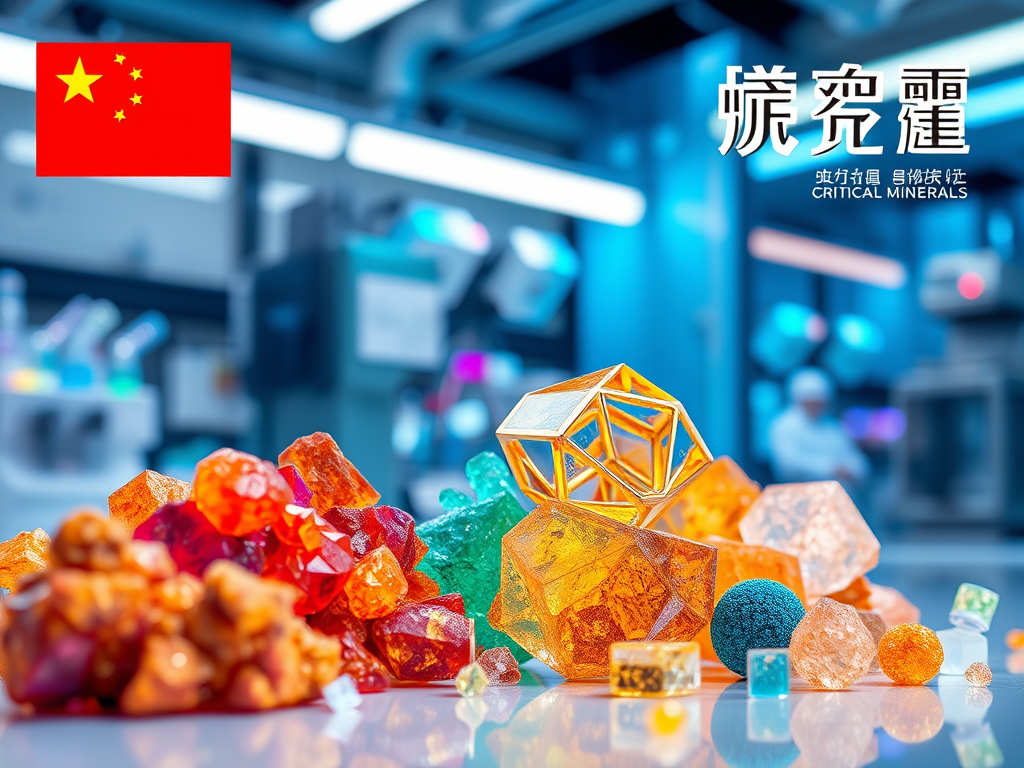
A colorful assortment of various geometric and crystalline shapes representing critical minerals, displayed against a blurred laboratory background. The image also features the flag of China and text in Chinese and English labeling the minerals.

Policy Framework Supporting Innovation Ecosystem

The Chinese State Council’s “Rare Earth Industry Development Plan (2021-2025)” establishes coordinated targets that explicitly connect mining output with downstream technology milestones. This policy framework differs from market-driven approaches where private investment decisions occur independently of government industrial planning.

Key coordination mechanisms include:

  • Research funding allocation aligned with five-year industrial development priorities
  • State-owned enterprise operations integrated with private sector innovation incentives
  • Regulatory environments designed to support domestic technology development clusters
  • University-industry partnerships with explicit commercialization mandates

Government research institutes, including Chinese Academy of Sciences divisions focused on materials science, receive dedicated funding for rare earth materials research aligned with broader industrial objectives. This creates predictable resource flows for long-term research projects while ensuring alignment between fundamental research and commercial applications.

The integration extends to environmental and regulatory considerations. Chinese facilities operate under different environmental compliance requirements compared to Western competitors, enabling cost structures that support both current operations and reinvestment in technology development. Additionally, these operations increasingly benefit from decarbonization benefits that enhance long-term competitiveness. This regulatory environment, combined with established supply chains and vertical integration advantages, creates compound benefits for innovation funding.

How Does China’s Patent Strategy Create Competitive Moats in Critical Technologies?

Intellectual Property Accumulation in Emerging Materials

China’s patent filing activity in rare earth materials significantly exceeds Western competitors, with China accounting for approximately 40-50% of global rare earth materials patents and higher percentages in emerging technology areas including nanomaterials and energy storage applications, according to World Intellectual Property Organization data from 2023.

Patent applications in rare earth nanomaterials and energy storage categories have grown at approximately 15-20% year-over-year in China between 2018-2023, while Western filing rates in equivalent categories have remained relatively flat or declined. This divergence reflects different strategic approaches to materials innovation and intellectual property development.

Focus areas for Chinese patent activity include:

  • Energy storage nanomaterials with enhanced conductivity and thermal stability
  • Magnetic separation processes optimizing cost structures and efficiency
  • Luminescent compounds for specialized optical and sensor applications
  • Advanced alloy compositions targeting aerospace and electronics sectors

Consequently, organizations must develop comprehensive IP protection strategies to safeguard their technological advantages in this competitive landscape.

Research Institution Networks and Knowledge Transfer

Chinese university-industry collaboration operates under different structural incentives compared to Western academic systems. Chinese institutions receive explicit mandates to commercialize research findings, supported by government incentive structures that reward technology transfer activities. This contrasts with Western university systems where commercialization typically occurs post-publication through licensing offices, creating longer development timelines.

Read more at: https://discoveryalert.com.au/strategic-technology-development-critical-material-sectors-2026/

Impact of #US Tariffs on #Canadian #Nickel Industry

Tariffs will disrupt the long-standing flow of nickel between Canada and the US

Canada is the single largest supplier of nickel metal to the US market, typically delivering between 35–40% of the United States’ annual primary nickel requirements over the past decade according to trade statistics and CRU’s Nickel Service. However, US President-Elect Donald Trump has announced potential 25% tariffs on Canadian imports, threatening to disrupt the flow of nickel across the border.

This will not only have a negative impact on the Canadian nickel industry, which is already struggling with high costs amid a global market in chronic surplus, but also on the US industry that needs a stable and secure source of high-purity nickel in a world that is increasingly dominated by China.

US market has no domestic nickel industry and is fully reliant on imports

In the US, nickel is largely used to make stainless steel followed by uses in foundry, alloying and plating applications – very little nickel is used domestically in battery applications. When it comes to stainless steel, the US has a mature scrap collection and distribution network meeting more than 80% of stainless-steel nickel requirement. The remainder needs to be secured by purchasing ferronickel or high-purity nickel. For all other applications, high-purity nickel is required.

The US has one operating nickel mine located in Michigan, owned by Lundin. This mine produces a concentrate that is exported, given the US has no domestic nickel smelters or refineries with the capability to process nickel-bearing concentrates. However, this mine is anticipated to exhaust its production by the end of 2025, leaving the US with no domestic nickel industry. As a result, the US will be completely reliant on imports to meet its primary nickel requirements.

Depending on the permanence of tariffs, US domestic nickel refining may become an attractive proposition and there is at least one company with plans to build a carbonyl nickel refinery producing high-purity nickel. However, the challenge this plant will have is sourcing intermediate feed.

Tariffs will push Canadian nickel to other markets

Although Canada is home to several large nickel producers, only one has the right surface assets and ore sources to be able to supply the US market from Canada. Vale produces high-purity nickel from its Sudbury and Long Harbor operations. However, its Canadian assets sit in the third and fourth quartile of CRU’s Net Cash Cost Excl. Royalties Industry Costs Curve.


Despite being positioned near the top of the cost curve, Vale’s operations appear to be able to turn a profit at YTD prices. However, when simulating for the impact of tariffs, Vale’s operations come under tremendous pressure.


Read more at: https://www.crugroup.com/en/communities/thought-leadership/2024/impact-of-us-tariffs-on-canadian-nickel-industry/

#DOE Announces $2.26 Billion Loan to #Lithium Americas Corp.

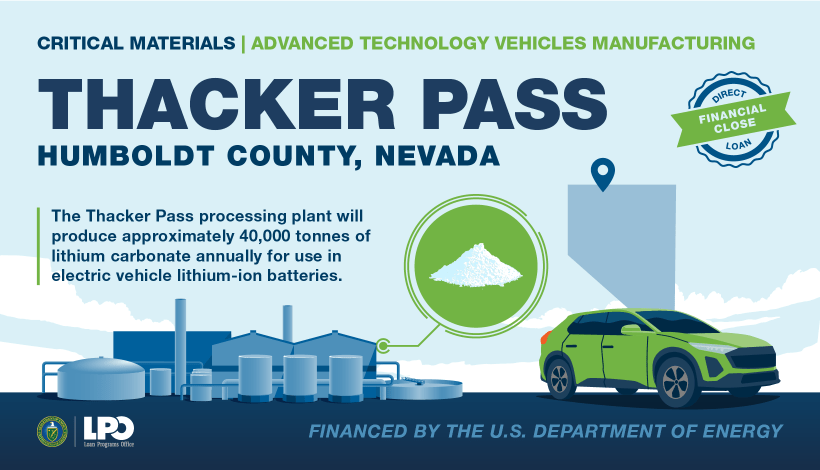
As part of the Biden-Harris Administration’s Investing in America agenda, the U.S. Department of Energy (DOE), through its Loan Programs Office (LPO), today announced the closing of a $2.26 billion loan to Lithium Americas Corp’s subsidiary, Lithium Nevada Corp. (including $1.97 billion of principal and $289.7 million of capitalized interest), to help finance the construction of facilities for processing lithium at Thacker Pass in Humboldt County, Nevada.

The project is located next to a mine site that contains the largest confirmed lithium resource in North America. Once fully operational, the facilities are expected to produce approximately 40,000 tonnes per year of battery-grade lithium carbonate—supporting good-paying, high-quality jobs while helping ensure the United States can meet anticipated skyrocketing demand for the critical minerals necessary for the clean energy future. Today’s announcement reinforces the Biden-Harris Administration’s whole-of-government approach to building America’s clean transportation future, boosting America’s global manufacturing competitiveness, and securing reliable domestic critical minerals supply chains.  

Read more at: https://www.energy.gov/lpo/articles/doe-announces-226-billion-loan-lithium-americas-corp

#China to regulate #Lithium-ion battery industry amid fast expansion

China’s Ministry of Industry and Information Technology on Wednesday issued new guidelines for its lithium-ion battery industry, aiming to transform, upgrade and promote high-quality development amid rapid expansion in the sector.

The guidelines, following a proposal in May, will help firms scale back manufacturing projects that only expand production capacity, while enhancing technology innovation and product quality and trimming output costs, the ministry said.

Projects built on farmland and ecological zones would be required to be shut down, or strictly reined in and gradually removed.

Rapid expansion of production capacity along the lithium battery supply chain has led to a plunge in prices for products, including battery and raw materials, eroding companies’ profits in the world’s biggest market.

Industry planning and launch of new projects should be in line with national development of resources, ecological protection and energy saving management, the ministry said.

Read more at: https://www.reuters.com/markets/commodities/china-regulate-lithium-ion-battery-industry-amid-fast-expansion-2024-06-19/

#Scientists find new way to enhance durability of #Lithium batteries.

Safe and efficient energy storage is important for American prosperity and security. With the adoption of both renewable energy sources and electric vehicles on the rise around the world, it is no surprise that research into a new generation of batteries is a major focus. Researchers have been developing batteries with higher energy storage density and, thus, longer driving range. Other goals include shorter charging times, greater tolerance to low temperatures and safer operation.

One of the more promising such batteries has a lithium-containing cathode supplemented with nickel, manganese and cobalt (NMC). At the U.S. Department of Energy’s (DOE) Argonne National Laboratory, a team of scientists has recently developed a new coating method for NMC cathodes with high nickel content, which boosts the energy density substantially. The cathode is the positively charged battery component that supplies lithium ions that shuffle between it and the battery’s negatively charged electrode, called the anode, during cycling.

The repeated charging of batteries under conditions of high voltage and rapid recharge leads to structural instability and breakdown over time. To overcome the problem, Argonne scientists developed a new coating that allows the cathode particles to withstand the fracturing in their crystalline structure that had previously occurred upon cycling. They call this material ​“epitaxial entropy-assisted coating,” or EEC for short. According to Xu, ​“entropy assistance” ensures that the coating helps to prevent the breakdown of the material beneath it due to a thermodynamic effect, which leads materials to naturally become destabilized over time.

Read more at: https://www.anl.gov/article/scientists-find-new-way-to-enhance-durability-of-lithium-batteries

#India reaches out to critical mineral producers for processing technology

NEW DELHI: India has reached out to key critical mineral producers to bring in processing technology into the country, officials said. The move comes close on the back of the government rolling out auctions of critical mineral mines.

“Talks are on with the United States (US), Australia, and United Kingdom (UK), South Korea, and Japan for processing technology. Brazil and Argentina are also positive about collaborating with India,” a senior mines ministry official told ET.
According to another official aware of the plan, agreements with countries are being lined up and will soon be signed.

While India is going ahead with auction of mines holding critical minerals, there are no facilities for their beneficiation.

“We want to target India’s first critical mineral beneficiation and processing plant in the next 3-5 years,” the official quoted above said. “We want to ensure that development of critical mineral processing and extraction happen in parallel.”

Read more at: https://economictimes.indiatimes.com/industry/indl-goods/svs/metals-mining/india-reaches-out-to-critical-mineral-producers-for-processing-technology/articleshow/108924719.cms?from=mdr

#Pentagon plans #AI-based program to estimate prices for critical minerals

The US Department of Defense plans to develop a program to estimate prices and predict supplies of nickel, cobalt and other critical minerals, a move aimed at boosting market transparency but one that throws a new, uncertain variable into global metals markets.

The program, which received little attention after it was announced on a Pentagon website in October, is part of Washington’s broader efforts to jumpstart US production of critical minerals used in weapons manufacturing and the energy transition.

US output lags market leader China partly because attempts to build new American mines can be heavily influenced by commodity price swings.

The Pentagon’s work is being run by its Defense Advanced Research Projects Agency (DARPA) division, which was formed in response to the Soviet Union’s 1957 launch of the Sputnik 1 satellite and helped develop the Internet and the mRNA vaccine for Covid-19.

DARPA and the US Geological Survey plan to hire one or more private contractors to develop an artificial intelligence-backed model that would construct a metal’s “structural price” based on where and when it is produced, as well as labor, supply and other costs, according to documents seen by Reuters that describe the program, including a slide deck that DARPA presented last November to prospective contractors.

Read more at: https://www.mining.com/web/pentagon-plans-ai-based-program-to-estimate-prices-for-critical-minerals/?utm_source=Daily_Digest&utm_medium=email&utm_campaign=MNG-DIGESTS&utm_content=pentagon-plans-aibased-program-to-estimate-prices-for-critical-minerals