Tag Archives: Japan

#G7 aims take on #China without launching a new trade war – #China supply no more than 60% of #RareEarthElements

A world map illustrating the G7 Global Alliance for Resilient Supply Chains, highlighting various countries, their industrial hubs, and strategic minerals like lithium, cobalt, and rare earth elements.

# The G7 Just Pledged to Break China’s Rare Earth Grip — There’s a Lot of Work to Do

For decades, the world’s advanced economies have enjoyed the benefits of globalization while quietly allowing a critical vulnerability to emerge: dependence on China for rare earth minerals and permanent magnets.

Now, the Group of Seven (G7) nations are finally attempting to confront that reality. At their recent summit in Evian, France, G7 leaders agreed on an ambitious goal: by 2030, no single country should account for more than 60% of their imports of rare earth elements and permanent magnets. Beyond that, they hope to reduce reliance further, targeting a 50% threshold as soon as possible.

The message is clear. The world’s leading democracies have concluded that China’s dominance over critical minerals has become both an economic and national security risk.

The challenge? Breaking that dependence may take far longer than the politicians would like.

## Why Rare Earths Matter

Rare earths are a group of 17 metallic elements that play an essential role in modern technology. On their own, these materials may seem obscure. But when processed into permanent magnets—particularly neodymium-iron-boron (NdFeB) magnets—they become indispensable.

These magnets are found in:

* Electric vehicles

* Wind turbines

* Smartphones

* Industrial robotics

* Military drones

* Precision-guided missiles

* Radar systems

* Advanced defense technologies

Their unique properties allow manufacturers to build lighter, stronger, and more energy-efficient motors and electronic systems. In other words, rare earth magnets have become one of the foundational technologies of the 21st century.

## China’s Dominance Is Overwhelming

China’s position in this market is difficult to overstate. The country currently accounts for roughly:

* 70% of global rare earth production

* Around 70% of critical mineral refining capacity

* Approximately 95% of rare earth permanent magnet manufacturing

This dominance wasn’t built overnight. For years, China invested heavily in mining, refining, processing expertise, and manufacturing infrastructure while many Western nations outsourced these activities due to environmental concerns, lower costs, and regulatory hurdles. The result is a supply chain where much of the world depends on China not merely for raw materials but for the highly specialized processing required to make those materials usable.That processing stage has become the true strategic bottleneck.

## Why the G7 Is Acting Now

The urgency stems from recent geopolitical tensions.

Over the past several years, Beijing has increasingly used export controls on critical minerals as a policy tool. Since 2020, China has imposed multiple restrictions on key materials used in defense and clean energy technologies.

Last year, China introduced sweeping export controls on rare earths and other critical minerals, raising fears that manufacturing lines across North America, Europe, and Asia could face severe disruptions.

The issue became even more visible during escalating trade disputes with the United States and amid growing tensions surrounding Taiwan.

Officials across the G7 have come to a sobering realization:

If China chose to significantly restrict exports, major sectors of the global economy could be affected almost immediately. The International Energy Agency has warned that trillions of dollars of economic activity outside China could be exposed to supply disruptions if export controls were fully implemented.

For military planners, the concern is even more immediate. Rare earth magnets are embedded in everything from fighter aircraft and missile guidance systems to surveillance drones. Dependence on a geopolitical rival for these materials creates a strategic vulnerability few governments are comfortable accepting.

## Lessons From Japan

The G7 is not the first group to recognize this problem. Japan learned the lesson more than a decade ago. In 2010, following a maritime dispute with China, Japanese companies suddenly found themselves facing restrictions on rare earth exports. Tokyo responded with a long-term strategy to diversify suppliers, invest in overseas mining projects, and build stockpiles. Yet even after more than 15 years of effort, Japan still sources roughly 75% of its rare earth imports from China.

That reality offers a sobering perspective on the G7’s latest pledge.

Diversification is possible. Rapid diversification is much harder.

## Building a Western Supply Chain

Despite the challenges, efforts are underway to create alternative supply chains. In the United States, several companies are positioning themselves as key players in what policymakers increasingly call a “mine-to-magnet” strategy.

### MP Materials

MP Materials operates Mountain Pass in California, the only commercial-scale rare earth mine in the United States.

The company has also expanded processing and magnet manufacturing capabilities in Texas and recently received significant support from the U.S. Department of Defense to strengthen domestic separation and refining capacity.

Its goal is straightforward: reduce reliance on Chinese processing and create a fully integrated American supply chain.

### USA Rare Earth

Another emerging player is USA Rare Earth. The company is developing mining, processing, and magnet manufacturing operations designed to produce rare earth permanent magnets domestically. Backed by federal incentives through the CHIPS and Science Act, the company aims to establish large-scale production capabilities and become a cornerstone of a Western rare earth ecosystem. These efforts represent important progress. But they are only the beginning.

## The Hard Part: Heavy Rare Earths

One major complication is that not all rare earths are equal. Many Western projects focus primarily on so-called “light” rare earth elements.

China, however, remains especially dominant in the production and processing of “heavy” rare earths—materials that are crucial for many advanced defense and high-performance industrial applications. Without secure access to these heavier elements, building a truly independent magnet supply chain remains difficult. Industry experts caution that current Western investments, while encouraging, do not yet solve this deeper problem.

## Obstacles Ahead

The G7’s target may be politically appealing, but achieving it will require overcoming significant obstacles.

### Capital Requirements

Mining and refining projects require billions of dollars in investment before they produce meaningful output.

### Regulatory Challenges

Permitting new mines can take years, particularly in North America and Europe.

### Environmental Concerns

Rare earth extraction and refining are energy-intensive and can create substantial environmental impacts if not carefully managed.

### Community Opposition

Many proposed mining projects face local resistance regardless of their strategic importance.

### Technical Expertise

China’s advantage isn’t just geological.

It also possesses decades of accumulated processing knowledge, engineering expertise, and industrial capacity that cannot be replicated overnight.

## More Than Mining

Recognizing these realities, G7 leaders are discussing additional measures beyond simply opening new mines.

These include:

* Expanding recycling of rare earth materials

* Developing strategic stockpiles

* Supporting refining and processing facilities

* Creating industrial procurement quotas

* Coordinating investments across allied nations

Defense manufacturing may become a particular focus, with governments potentially requiring portions of critical materials to come from non-Chinese sources. Such policies could help create the guaranteed demand necessary for new projects to attract financing.

## The Bottom Line

The G7’s commitment marks one of the strongest collective efforts yet to reduce dependence on China for critical minerals. The goal is ambitious, and perhaps necessarily so. Without clear targets, governments and industries often fail to act. But ambition alone will not be enough.

China’s dominance in rare earths was built over decades through sustained investment, industrial policy, and strategic planning. Reversing that dominance will require the same level of long-term commitment from the United States, Europe, Japan, and their allies.

The good news is that the process has begun. The difficult reality is that diversification is not a five-year project—it may be a generation-long effort.

The G7 has taken an important first step.

Now comes the hard part: turning a political pledge into a functioning supply chain.

Shin-Etsu’s New #RareEarth Refinery: Strengthening #Japan’s Supply Chain

Global supply chains map highlighting the flow of rare earth elements and strategic resources. Features regions like North America, South America, Europe, Asia, and Australia connected by colorful supply chain routes and resource flows. Key insights include diversified sourcing and sustainability.

Shin-Etsu Chemical Co., one of Japan’s leading producers of rare earth magnets, is planning to construct a new rare earth refining facility in Japan as part of its strategy to strengthen supply chain resilience and reduce dependence on China.

The new refinery, which will be the company’s third facility in Fukui Prefecture in western Japan, is intended to enhance Shin-Etsu’s ability to maintain a stable supply of rare-earth products and permanent magnets. While the company has not disclosed the project’s capacity, schedule, or investment value, reports from the Nikkei indicate that the development will require an investment exceeding ¥35 billion (approximately US$218 million), with nearly half of the funding expected to come from government subsidies.

Rare earths have become increasingly important from both economic and geopolitical perspectives, as major economies seek to diversify supply sources and reduce China’s dominance in rare earth mining and processing. The issue is expected to feature prominently at the upcoming G7 summit in France.

Japan has also faced supply challenges following China’s suspension of exports of certain critical materials since early 2026, amid ongoing diplomatic tensions linked to comments made by Japanese Prime Minister Sanae Takaichi regarding Taiwan.

According to analysts at Citigroup, the Shin-Etsu project is considered strategically important from a national security standpoint. Shin-Etsu is one of Japan’s three major magnet manufacturers, alongside TDK Corp. and Proterial Ltd. In addition to its two existing facilities in Fukui, the company also operates a rare earth business in Vietnam.

Source: Bloomberg

Quad members (#US, #Japan, #Australia and #India) unveil $20bn #CriticalMinerals initiative

A visually engaging graphic depicting the planet Earth with highlighted continents, featuring the flags of India, Japan, the United States, and Australia. The design emphasizes connections between these countries, labeled 'Critical Minerals QUAD Members,' with glowing effects and illustrations of network lines.

The US, Japan, Australia and India have unveiled a $20 billion framework to strengthen critical minerals supplies as Washington continues to seek ways to loosen China’s stronghold.

The four Quad partners said they intend to raise up to $20 billion in public and private sector support to boost critical minerals supply chains that includes mining, processing and recycling by identifying projects in member countries.

“Through the Quad Critical Minerals Initiative, Quad partners intend to work together to use economic policy tools and co-ordinated investment to accelerate the development of diversified and fair critical mineral markets. and support the supply of critical minerals that are crucial to our region’s economic growth and security,” the members said in a statement.e 

Monday’s announcement followed US Secretary of State Marco Rubio’s visit to India, where he and Quad foreign ministers also announced initiatives to strengthen maritime and transnational security, emerging technology and humanitarian assistance.

Under the critical minerals agreement, the Quad partners said they would support strategic projects through export credit agencies, private capital, development financial institutions, and explore new ways to raise private capital in the critical minerals space.

Critical minerals are used to produce advanced technology, defence systems, electric vehicles and other technologies in the clean energy transition.

Read more at: The National News

#Japan tackles challenges of seafloor #RareEarth mining, eyeing economic security

An underwater scene featuring a deep-sea mining vehicle near Japan, with the Japanese flag in the background. The text highlights Japan's advancements in deep-sea technology, referencing a depth of 6,000 meters.

Japan’s government is taking on the challenge of mining critical minerals, including rare earths, from the seabed around Minamitorishima, a remote Japanese island in the Pacific, with an eye to realizing domestic rare earth production in the future.

Securing such minerals is a matter of vital importance for Japan, which is poor in natural resources. In February of this year, the country succeeded in a test collection of rare earth-bearing mud at a depth of 6,000 meters below sea level near the island, which is in the Tokyo village of Ogasawara.

While commercialization is being targeted for 2028 at the earliest, the government faces the challenge of striking a balance between the importance of the mining for economic security and its economic viability.

Rich mineral resources are believed to lie in the ocean floor around Minamitorishima. Cobalt-rich crusts and manganese nodules have been found there. Cobalt and manganese are used for electric vehicle batteries.

Furthermore, the presence of mud containing scarce and expensive heavy rare earth elements, such as neodymium and dysprosium, has also been confirmed, and development is being promoted under government leadership. Neodymium and dysprosium are needed for high-performance motors used in EVs and wind power generators.

“We have promoted technical development over the years to make the world’s first attempt” at deep-sea rare earth mining, said Shoichi Ishii, an official at the Cabinet Office who is leading the rare earth-rich mud development project.

Read more at: Japan Times

#Australia-#Japan Joint Statement on Elevated #CriticalMinerals Cooperation

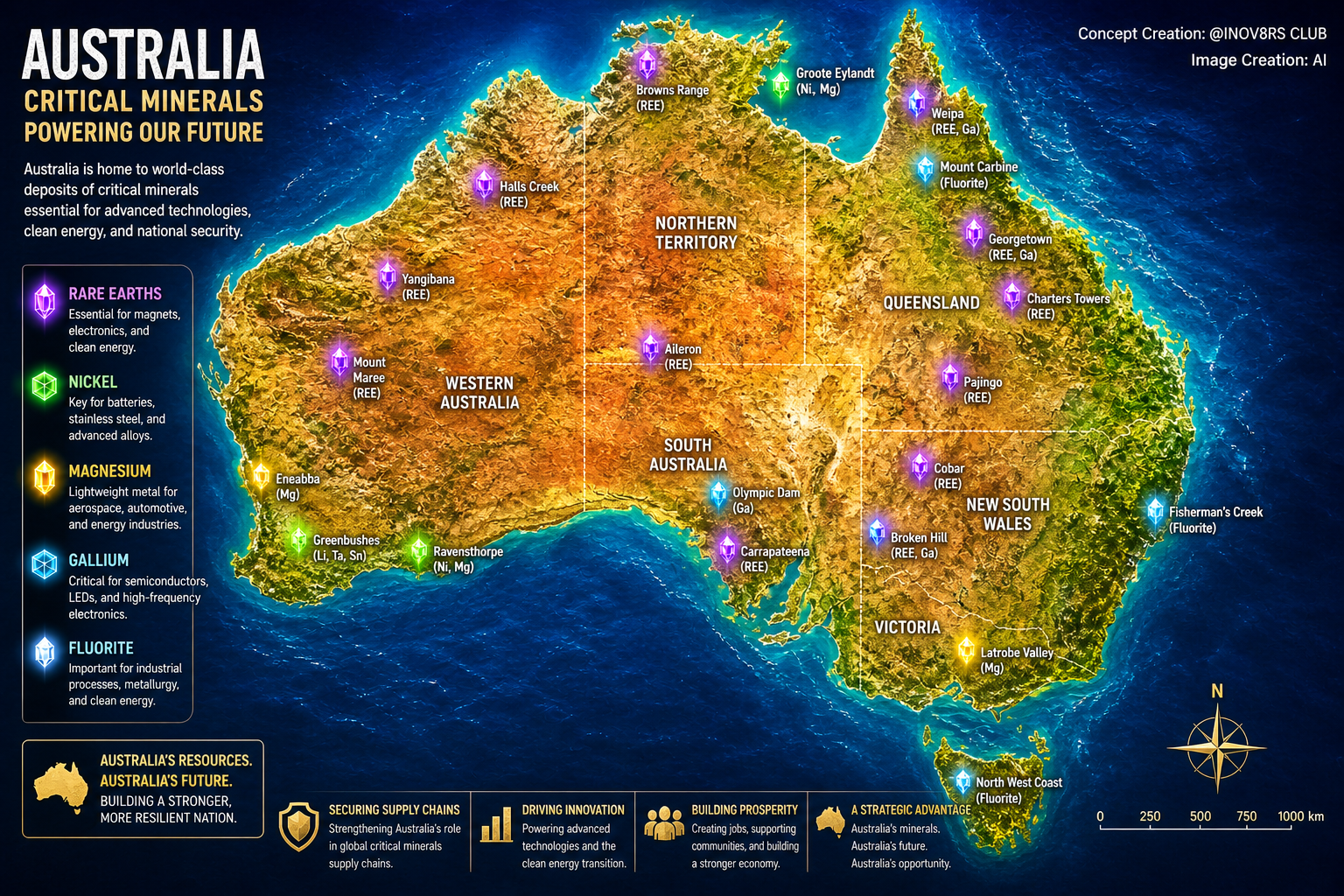
Map of Australia highlighting major regions rich in critical minerals essential for technology, clean energy, and national security. Locations include deposits of rare earths, nickel, magnesium, gallium, and fluorite across various states.

The two Governments have already identified the following key projects that have the potential to materially diversify the supply chains for critical minerals:

  • Lynas Rare Earths Project
    A flagship initiative symbolising collaboration between Japanese and Australian industry on critical minerals. In 2011, a joint venture (JARE) between Sojitz Corporation and JOGMEC provided equity and loan financing to Lynas Rare Earths to commence light rare earth production. In 2025, the project reached a further milestone with the commencement of heavy rare earth production.
  • Alcoa Gallium Recovery Project
    This project involves Alcoa working with Japan Australia Gallium Associates (JAGA)—a joint venture between Sojitz and JOGMEC—to develop gallium recovery at one of Alcoa’s operating alumina refineries in Western Australia, for use in semiconductors, LEDs, and solar cells. The project is planning to be supported by equity investment from the Governments of Japan, Australia, and the United States.
  • Magnium Magnesium Project
    Magnium Australia is planning the commercial production of high‑purity magnesium, widely used in lightweight applications including the automotive and aerospace sectors, in Western Australia using a low‑carbon process with reduced environmental impact. Hanwa Co. Ltd., a Japanese trading company, as well as the Government of Japan, has also expressed interest in this initiative.
  • Tivan Fluorite Project
    The Speewah Fluorite Project, located in Western Australia, is a Japanese Government‑supported initiative involving a joint venture between Sumitomo Corporation and JOGMEC, in collaboration with Tivan Limited, to produce acid‑grade fluorite, a key raw material for hydrofluoric acid used in semiconductors, EVs, and other advanced applications. It has also received a non-binding and conditional Letter of Support from EFA.
  • RZ Resources Critical Minerals Project
    The Copi Critical Minerals Project in New South Wales is a mineral sands project, looking to develop supply of critical minerals and rare earth elements, owned by RZ Resources, with participation from JX Metals Corporation and Marubeni Corporation. It has also received non-binding indications of support as a critical minerals project from EFA and the U.S. Export Import Bank.
  • Ardea Resources Kalgoorlie Nickel Project
    The Kalgoorlie Nickel Project – Goongarrie Hub is one of the largest nickel cobalt resources in Australia. The project is being developed as a joint venture with Ardea Resources, Sumitomo Metal Mining, and Mitsubishi Corporation. The Government of Japan has provided funding support under its economic security grant towards building a resilient and secure critical minerals supply chain. The project has received non-binding and conditional indications of support from EFA and the U.S. Export Import Bank. The Australian Government has selected Ardea to participate in its investor front door pilot, which aims to streamline project engagement with government.

Read more at: Department of the Prime Minister and Cabinet

Ardea – Western #Australian #Nickel project grabs #Japanese – #US attention

A silhouette of Australia filled with an industrial landscape featuring mining activity, overlaid with the flags of the United Kingdom, United States, and Japan, symbolizing international relationships.

Ardea Resources’ Kalgoorlie nickel project (KNP) has received a shout-out in the Japan-US Critical Minerals Joint Fact Sheet, a call-to-action to shore up critical mineral supply chains between the two powerful nations and other Western markets.

The company’s nickel-cobalt project, about 70 kilometres north of the city of Kalgoorlie-Boulder in Western Australia, comprises its bulk-scale KNP – Goongarrie Hub and hosts a mammoth 854 million tonnes grading 0.71 per cent nickel and 0.045 per cent cobalt for a whopping 6.1 million tonnes of contained nickel and 386,000 tonnes of cobalt.Ardea Resources’ Kalgoorlie nickel project (KNP) has received a shout-out in the Japan-US Critical Minerals Joint Fact Sheet, a call-to-action to shore up critical mineral supply chains between the two powerful nations and other Western markets.

The company’s nickel-cobalt project, about 70 kilometres north of the city of Kalgoorlie-Boulder in Western Australia, comprises its bulk-scale KNP – Goongarrie Hub and hosts a mammoth 854 million tonnes grading 0.71 per cent nickel and 0.045 per cent cobalt for a whopping 6.1 million tonnes of contained nickel and 386,000 tonnes of cobalt.

Read more at: https://www.smh.com.au/business/companies/ardea-wa-nickel-project-grabs-japanese-us-attention-20260323-p5rupb.html

#US #CriticalMinerals talks advance with #EU, #Japan on price floor

A display of critical metals featuring a metal ingot labeled 'CRITICAL METALS', two batteries, and assorted rocks, with the flags of the United States, European Union, and Japan in the background alongside the Statue of Liberty and Tokyo Tower.

The US, Japan and the European Union are set to announce plans in the coming weeks to lay the foundation for a trade agreement in critical minerals, according to people familiar with the preparations.

The Office of the US Trade Representative, which has led negotiations with Brussels and Tokyo on the framework, will also head talks for a trade deal that is set to include a price floor and tariffs for the materials to counter any market distortions by China, said the people, who spoke on the condition of anonymity.

Global efforts to diversify critical minerals supply chains intensified after Beijing last year imposed sweeping export controls, including on rare earths and critical minerals, in response to President Donald Trump’s so-called Liberation Day tariffs, which set a 10% levy on nearly all American imports.

Beijing has threatened it would retaliate against the formation of a bloc that would target its exports.

The supply crunch has eased somewhat since its worst point last summer and fall, but companies still complain that they don’t receive the quantities they need and have ordered from Chinese suppliers.

Read more at: https://www.mining.com/web/us-advance-critical-minerals-talks-with-eu-japan-on-price-floor/

#Japan, #France and #Canada work on alternatives to #US-led trade bloc for #RareEarth supplies  

A collage featuring critical minerals and rare earth elements, with landmarks from Japan, France, and Canada. Includes a magnet, smartphone, electronic components, and an electric car charging.

Group of Seven members Japan, France and Canada are working on alternatives to a U.S.-led ​trade bloc to secure critical minerals and reduce reliance on China, according to three senior officials from these countries.

Some ‌options include import quotas on certain rare earths, subsidies for mining companies to diversify the supply chain on critical minerals, and a buyers’ club,a Canada-led G7 initiative that aims to develop a reliable supply chain of critical minerals outside of China and break that country’s monopoly on these metals.

Rare earths are difficult-to-extract metals used in cell phones, EVs, and high-tech weapons. China currently controls over 90% of these metals and imposed export ​controls last year in retaliation for U.S. tariffs.

Japan has asked its manufacturing industries to strike commercial deals with rare earths projects that ​it has funded with allies such as France, Australia, and Canada.

“They might not be the cheapest, but now that the industry understands the balance of ‌risk ⁠and price, it is not a bad idea to use those projects,” Hatada explained.

Benjamin Gallezot, France’s interministerial delegate for supplies of strategic minerals and metals, told Reuters the U.S. proposal is one way to diversify, “but there are other ways to do it.” “There will not be a general policy, that is our view. Second, it has to be built and discussed between a large number of countries, not only ​the G7, but G7 plus.”

Read more at: https://www.reuters.com/world/asia-pacific/japan-france-canada-work-alternatives-us-led-trade-bloc-rare-earth-supplies-2026-03-06/

#India reaches out to critical mineral producers for processing technology

NEW DELHI: India has reached out to key critical mineral producers to bring in processing technology into the country, officials said. The move comes close on the back of the government rolling out auctions of critical mineral mines.

“Talks are on with the United States (US), Australia, and United Kingdom (UK), South Korea, and Japan for processing technology. Brazil and Argentina are also positive about collaborating with India,” a senior mines ministry official told ET.
According to another official aware of the plan, agreements with countries are being lined up and will soon be signed.

While India is going ahead with auction of mines holding critical minerals, there are no facilities for their beneficiation.

“We want to target India’s first critical mineral beneficiation and processing plant in the next 3-5 years,” the official quoted above said. “We want to ensure that development of critical mineral processing and extraction happen in parallel.”

Read more at: https://economictimes.indiatimes.com/industry/indl-goods/svs/metals-mining/india-reaches-out-to-critical-mineral-producers-for-processing-technology/articleshow/108924719.cms?from=mdr

Jamaica, Japan start cooperation on rare earth extraction

Jamaica and Japan on Monday started cooperation on rare earth extraction by breaking ground for a pilot plant amid concerns from local environmentalists.

The plant in St. Andrew, funded by Japanese company Nippon Light Metal with initial investment of 3 million US dollars, is expected to extract some 1,500 metric tonnes of rare earth oxides annually from Jamaican red mud.

http://www.globaltimes.cn/content/760274.shtml