In a rapidly shifting global landscape, we are building One Canadian Economy turbo-charged by major nation-building projects that unleash our natural resources, diversify our products and markets and create hundreds of thousands of high-paying careers for our workers, all while protecting the environment and upholding the rights of Indigenous Peoples.
Honourable Tim Hodgson, Minister of Energy and Natural Resources, visited Canada Nickel Company’s Crawford Project to highlight the Government of Canada’s efforts to build one Canadian economy and build Canada’s leadership in the critical minerals sector.
The Crawford Project will serve as an anchor of Canada’s global leadership in clean industrial materials. Located in the world’s second-largest nickel reserve, the Crawford Project will produce high-quality, low-carbon nickel essential for batteries and green steel. With projected emissions 90 percent below the global average and the potential for a net-negative carbon footprint, it represents a model for the future of responsible mining. Canada Nickel is also planning an expansion to commence once mining operations have started, which would include producing other metals such as iron, cobalt, platinum, palladium and chromium; developing a nickel refinery for stainless steel and electric vehicle markets; and planning to construct a stainless steel and alloy production facility. The project is expected to attract $5 billion in investment and could create 4,000 new careers, securing Canada’s place at the forefront of the clean economy.
Dar es Salaam. The planned groundbreaking ceremony for the Kabanga Nickel Project, set for October this year, will go ahead as scheduled despite BHP Group’s decision t sell its 17 percent stake in Kabanga Nickel Limited (KNL) to Lifezone Metals Limited.
Lifzone, the parent company of KNL, announced on July 18 that it had completed a definitive agreement with BHP Billiton (UK) DDS Limited to acquire the mining giant’s entire equity interest in KNL. As a result, Lifezone now owns 100 percent of KNL, which in turn holds an 84 percent stake in Tembo Nickel Corporation Limited (TNCL) – the operating equity for the Kabanga project.
A group of battery metal exploration companies and startups says it has a plan to turbocharge Canada’s critical minerals sector by building out “midstream” mineral processing facilities in Western Canada.
Two reports published by the Battery Metals Association of Canada, which hired analysts at the Transition Accelerator to consult with their members, identified nine critical minerals — copper, graphite, iron, nickel, lithium, phosphate, rare earths and vanadium — and five regions where they see big opportunities for major projects.
For example, British Columbia has at least four producing copper mines, which all ship their copper concentrate overseas, primarily to China, because there are no smelters in Western Canada. Building a copper smelter could encourage copper production and exploration while also creating higher-value products to sell, the reports said.
“If you wanted to put together a critical minerals processing behemoth anywhere in the world, the assets that we have in Alberta to do that are just phenomenal,” Bentley Allan, a professor of political economy at Johns Hopkins University and a principal at Transition Accelerator, said. “It has the chemical processing expertise, the clean power resources, other kinds of machining and precision instruments, which make Alberta a really incredible place to do this.”
North Americans and Europeans need reliable processes to refine both light and heavy rare earth metals.
The processes currently available in North American and Europe to refine light and heavy rare earth elements do not meet the economic and environmental standard.
Prior to going into mining in unexplored part of the world:
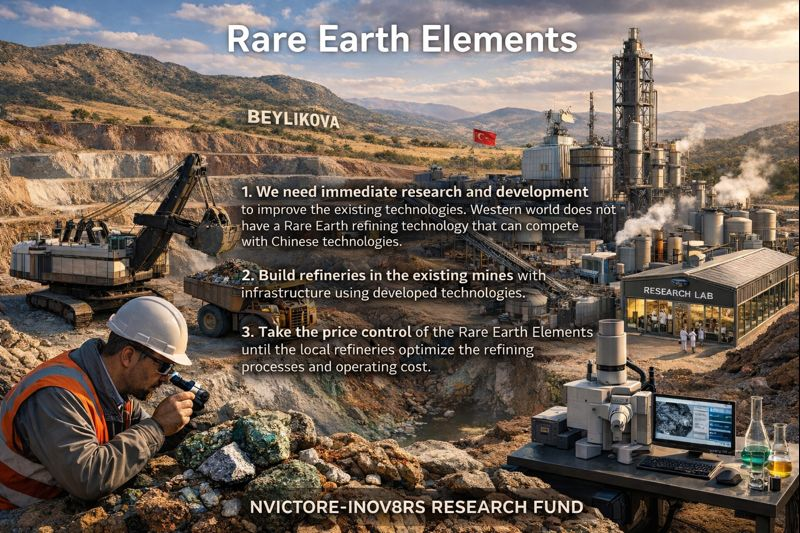
1. We need immediate research and development to improve the existing technologies.
2. Build refineries in the existing mines with infrastructure using developed technologies.
3. Take the price control of the Rare Earth Elements by tariffs or other means until the local refineries optimize the refining processes and operating cost.
We do not want to send the concentrate to another country to do final refining.
Process Development:
“Two different rare earth elements may be fractions of an angstrom different in diameter — that means it’s very difficult to separate using physical means. The processes that are used right now … can be 100 steps,” Chrisey said, also noting that the procedure can be very expensive and environmentally hazardous due to the chemicals used to separate and purify the metals.
Molycorp was struggling to stay solvent. Those new innovative technologies? They didn’t generate significant revenue or work as designed. By 2013, the company’s revenues were in free fall.
Molycorp’s most profitable assets being transferred to Chinese-linked Neo Materials, where he formerly served as CEO. Molycorp’s final remaining husk declared bankruptcy in 2014. Unsurprisingly, the majority of Neo Materials’ revenue-producing operations are now in China. To make matters worse, the Mountain Pass mine was purchased out of bankruptcy by a consortium that included a Chinese-owned firm.
Mountain Pass was now sending U.S.-mined rare earth concentrate to China for processing. The dream of a one-stop American rare earths solution was over, and the private sector had little appetite for reviving it.
Crucial innovation is also needed to break China’s stranglehold on the sector without sacrificing environmental quality, industry analysts said, with concerns over current processes’ toxic waste impeding projects.
Technical complexities, partnership strains and pollution concerns are hampering companies’ ability to wrest market share away from China, which according to the International Energy Agency controls 87% of global rare earths refining capacity.
Late last year, U.S.-based MP said it was commissioning refining equipment near its California mine as part of an intricate calibration process that has so far not succeeded, leaving the company reliant on China for refining and thus nearly all of its revenue.
The town of Mountain Pass, California, is home to the largest rare-earth element mine in the U.S. Its story began in the 1940s, when prospectors went searching for uranium.
The U.S. contains potential sources for many of them, and powerful voices in politics and business insist that the country must exploit them. But despite skyrocketing demand for the energy-critical elements, would-be domestic producers just can’t compete with global forces. This then is a story of comprehensive failure — but not the obvious one. Molycorp’s impending demise reflects failure by politicians and the media to understand how weak China’s grip on the metals market really is, and failure by Wall Street to understand the most basic dynamics of supply and demand, and failure by Silicon Valley to distinguish between hype and hard numbers.
China’s refining expertise has allowed the country to engineer rare earths prices at different stages in the processing chains to its advantage, including low prices for finished products, to inhibit foreign competition.
Beijing for years has allowed imports of lightly processed rock known as rare earths concentrate for refining. The strategy helps ensure prices that incentivize other countries to dig new mines but not build processing plants.
China plans to prohibit non-state companies from mining rare earths, further tightening its control over a strategic sector that has emerged as a battleground in its trade war with the US. The government said only large state-owned groups can mine, smelt or separate the minerals and proposed banning private firms from the activities, according to draft rules issued by the Ministry of Industry and Information Technology.
As part of the Biden-Harris Administration’s Investing in America agenda, the U.S. Department of Energy (DOE), through its Loan Programs Office (LPO), today announced the closing of a $2.26 billion loan to Lithium Americas Corp’s subsidiary, Lithium Nevada Corp. (including $1.97 billion of principal and $289.7 million of capitalized interest), to help finance the construction of facilities for processing lithium at Thacker Pass in Humboldt County, Nevada.
The project is located next to a mine site that contains the largest confirmed lithium resource in North America. Once fully operational, the facilities are expected to produce approximately 40,000 tonnes per year of battery-grade lithium carbonate—supporting good-paying, high-quality jobs while helping ensure the United States can meet anticipated skyrocketing demand for the critical minerals necessary for the clean energy future. Today’s announcement reinforces the Biden-Harris Administration’s whole-of-government approach to building America’s clean transportation future, boosting America’s global manufacturing competitiveness, and securing reliable domestic critical minerals supply chains.
The Canadian province of Saskatchewan has vowed to compete with China in processing and production of rare earths and become the first North American commercial alternative source for the metals, used to make magnets for electric vehicles and wind turbines.
The Saskatchewan Research Council Rare Earth Processing facility is betting on demand for these magnets to jump in the next couple of years, driven by demand from original equipment manufacturers such as automakers.
The SRC Rare Earth processing facility has begun production on a commercial scale and expects to hit a production target of 40 tonnes of rare earth metals per month by the end of this year. And it will produce 400 tonnes of the NdPr metals per year, which is enough to produce 500,000 EVs, according to SRC. The facility has already tied up with potential clients in South Korea, Japan and the United States.
China’s Ministry of Industry and Information Technology on Wednesday issued new guidelines for its lithium-ion battery industry, aiming to transform, upgrade and promote high-quality development amid rapid expansion in the sector.
The guidelines, following a proposal in May, will help firms scale back manufacturing projects that only expand production capacity, while enhancing technology innovation and product quality and trimming output costs, the ministry said.
Projects built on farmland and ecological zones would be required to be shut down, or strictly reined in and gradually removed.
Rapid expansion of production capacity along the lithium battery supply chain has led to a plunge in prices for products, including battery and raw materials, eroding companies’ profits in the world’s biggest market.
Industry planning and launch of new projects should be in line with national development of resources, ecological protection and energy saving management, the ministry said.
Safe and efficient energy storage is important for American prosperity and security. With the adoption of both renewable energy sources and electric vehicles on the rise around the world, it is no surprise that research into a new generation of batteries is a major focus. Researchers have been developing batteries with higher energy storage density and, thus, longer driving range. Other goals include shorter charging times, greater tolerance to low temperatures and safer operation.
One of the more promising such batteries has a lithium-containing cathode supplemented with nickel, manganese and cobalt (NMC). At the U.S. Department of Energy’s (DOE) Argonne National Laboratory, a team of scientists has recently developed a new coating method for NMC cathodes with high nickel content, which boosts the energy density substantially. The cathode is the positively charged battery component that supplies lithium ions that shuffle between it and the battery’s negatively charged electrode, called the anode, during cycling.
The repeated charging of batteries under conditions of high voltage and rapid recharge leads to structural instability and breakdown over time. To overcome the problem, Argonne scientists developed a new coating that allows the cathode particles to withstand the fracturing in their crystalline structure that had previously occurred upon cycling. They call this material “epitaxial entropy-assisted coating,” or EEC for short. According to Xu, “entropy assistance” ensures that the coating helps to prevent the breakdown of the material beneath it due to a thermodynamic effect, which leads materials to naturally become destabilized over time.
NEW DELHI: India has reached out to key critical mineral producers to bring in processing technology into the country, officials said. The move comes close on the back of the government rolling out auctions of critical mineral mines.
“Talks are on with the United States (US), Australia, and United Kingdom (UK), South Korea, and Japan for processing technology. Brazil and Argentina are also positive about collaborating with India,” a senior mines ministry official told ET. According to another official aware of the plan, agreements with countries are being lined up and will soon be signed.
While India is going ahead with auction of mines holding critical minerals, there are no facilities for their beneficiation.
“We want to target India’s first critical mineral beneficiation and processing plant in the next 3-5 years,” the official quoted above said. “We want to ensure that development of critical mineral processing and extraction happen in parallel.”
Congo’s state mining group Gecamines said it will push to secure the rights to buy copper and cobalt at mines it has holdings in, as it attempts to build its own stocks and trade the metals.
To do so, Gecamines needs to amend some terms of its joint venture agreements in Democratic Republic of Congo, which is the world’s top supplier of battery-grade cobalt and the third largest copper producer after Peru and Chile.