Tag Archives: economy

#China’s #RareEarth Policy: Driving Innovation and Competitiveness
A colorful assortment of various geometric and crystalline shapes representing critical minerals, displayed against a blurred laboratory background. The image also features the flag of China and text in Chinese and English labeling the minerals.

Policy Framework Supporting Innovation Ecosystem

The Chinese State Council’s “Rare Earth Industry Development Plan (2021-2025)” establishes coordinated targets that explicitly connect mining output with downstream technology milestones. This policy framework differs from market-driven approaches where private investment decisions occur independently of government industrial planning.

Key coordination mechanisms include:

  • Research funding allocation aligned with five-year industrial development priorities
  • State-owned enterprise operations integrated with private sector innovation incentives
  • Regulatory environments designed to support domestic technology development clusters
  • University-industry partnerships with explicit commercialization mandates

Government research institutes, including Chinese Academy of Sciences divisions focused on materials science, receive dedicated funding for rare earth materials research aligned with broader industrial objectives. This creates predictable resource flows for long-term research projects while ensuring alignment between fundamental research and commercial applications.

The integration extends to environmental and regulatory considerations. Chinese facilities operate under different environmental compliance requirements compared to Western competitors, enabling cost structures that support both current operations and reinvestment in technology development. Additionally, these operations increasingly benefit from decarbonization benefits that enhance long-term competitiveness. This regulatory environment, combined with established supply chains and vertical integration advantages, creates compound benefits for innovation funding.

How Does China’s Patent Strategy Create Competitive Moats in Critical Technologies?

Intellectual Property Accumulation in Emerging Materials

China’s patent filing activity in rare earth materials significantly exceeds Western competitors, with China accounting for approximately 40-50% of global rare earth materials patents and higher percentages in emerging technology areas including nanomaterials and energy storage applications, according to World Intellectual Property Organization data from 2023.

Patent applications in rare earth nanomaterials and energy storage categories have grown at approximately 15-20% year-over-year in China between 2018-2023, while Western filing rates in equivalent categories have remained relatively flat or declined. This divergence reflects different strategic approaches to materials innovation and intellectual property development.

Focus areas for Chinese patent activity include:

  • Energy storage nanomaterials with enhanced conductivity and thermal stability
  • Magnetic separation processes optimizing cost structures and efficiency
  • Luminescent compounds for specialized optical and sensor applications
  • Advanced alloy compositions targeting aerospace and electronics sectors

Consequently, organizations must develop comprehensive IP protection strategies to safeguard their technological advantages in this competitive landscape.

Research Institution Networks and Knowledge Transfer

Chinese university-industry collaboration operates under different structural incentives compared to Western academic systems. Chinese institutions receive explicit mandates to commercialize research findings, supported by government incentive structures that reward technology transfer activities. This contrasts with Western university systems where commercialization typically occurs post-publication through licensing offices, creating longer development timelines.

Read more at: https://discoveryalert.com.au/strategic-technology-development-critical-material-sectors-2026/

#Nigeria to open two #Chinese-backed #Lithium processing plants this year

Note: Canada is a resource-rich country. Canada does not have to go to another continent for critical mineral. Canada needs investment and technology development (refining and recycling). Bring the investment to Canada.

LAGOS, May 26 (Reuters) – Nigeria is set to commission two major lithium processing plants this year, the country’s mining minister announced on Sunday, marking a shift from raw mineral exports towards adding value domestically.

The facilities, largely funded by Chinese investors, could help transform Nigeria’s vast mineral wealth into jobs, technology, and manufacturing growth within the country. Mining Minister Dele Alake said a $600 million lithium processing plant near the Kaduna-Niger border is slated for commissioning this quarter, while a $200 million lithium refinery on the outskirts of Abuja is nearing completion. Two additional processing plants are expected in Nasarawa state, which borders the capital Abuja, before the third quarter of 2025, the minister said. “We are now focused on turning our mineral wealth into domestic economic value – jobs, technology, and manufacturing,” Alake said. Over 80% of the funding for the four facilities has been provided by Chinese firms, including Jiuling Lithium Mining Company and Canmax Technologies, according to separate announcements by governors of the states where the plants are located.

Read more at: https://www.reuters.com/business/energy/nigeria-open-two-chinese-backed-lithium-processing-plants-this-year-2025-05-26/

Yes, Canada is considered a resource-rich country. It has abundant natural resources, including:

  1. Energy Resources:
    • Oil and Natural Gas: Canada has some of the largest reserves of oil in the world, particularly in the oil sands of Alberta. It is a major exporter of oil and natural gas, especially to the United States.
    • Hydroelectric Power: Canada is a leader in hydroelectricity production, with large dams and water resources, especially in provinces like Quebec and British Columbia.
  2. Minerals and Metals:
    • Gold, Silver, and Platinum: Canada has significant reserves of precious metals, making it one of the largest producers of gold and other precious metals.
    • Nickel, Copper, and Zinc: The country is a leading producer of these metals, which are essential for various industries, including manufacturing and electronics.
    • Uranium: Canada is one of the world’s top producers of uranium, used in nuclear power generation.
  3. Forests:
    • Canada has vast forest resources, making it one of the largest producers of timber and paper products. The forest industry is especially important in provinces like British Columbia and Quebec.
  4. Agricultural Resources:
    • Canada is a major producer of wheat, canola, and other crops. It also has extensive livestock farming, including cattle and poultry.
  5. Freshwater:
    • Canada holds around 20% of the world’s freshwater supply, making it an important resource for both domestic use and potential global trade.

These resources contribute significantly to Canada’s economy, especially through exports, and help maintain its position as one of the world’s wealthiest nations in terms of natural wealth

#DOE Announces $2.26 Billion Loan to #Lithium Americas Corp.

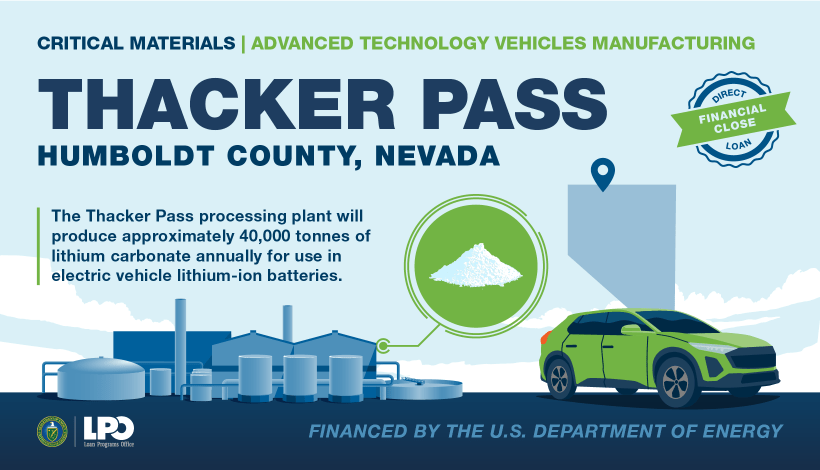
As part of the Biden-Harris Administration’s Investing in America agenda, the U.S. Department of Energy (DOE), through its Loan Programs Office (LPO), today announced the closing of a $2.26 billion loan to Lithium Americas Corp’s subsidiary, Lithium Nevada Corp. (including $1.97 billion of principal and $289.7 million of capitalized interest), to help finance the construction of facilities for processing lithium at Thacker Pass in Humboldt County, Nevada.

The project is located next to a mine site that contains the largest confirmed lithium resource in North America. Once fully operational, the facilities are expected to produce approximately 40,000 tonnes per year of battery-grade lithium carbonate—supporting good-paying, high-quality jobs while helping ensure the United States can meet anticipated skyrocketing demand for the critical minerals necessary for the clean energy future. Today’s announcement reinforces the Biden-Harris Administration’s whole-of-government approach to building America’s clean transportation future, boosting America’s global manufacturing competitiveness, and securing reliable domestic critical minerals supply chains.  

Read more at: https://www.energy.gov/lpo/articles/doe-announces-226-billion-loan-lithium-americas-corp