Category Archives: Related Inventions

#Vale will sell 14% stake in Vale #Indonesia – minister

JAKARTA, Nov 10 (Reuters) – Mining company Vale will sell a 14% stake in its Indonesian nickel miner Vale Indonesia to bring the holding by overseas firms below the maximum limit, Indonesia’s mining minister said on Friday.

Share divestment is a condition Indonesia requires to extend the operation permit for Vale Indonesia. Vale’s current contract is due to end in 2025.

Under Indonesian rules, foreign investors are required to divest 51% of their stake to local buyers after a certain period of operation.

Read more at: https://www.reuters.com/markets/commodities/vale-will-divest-14-stake-vale-indonesia-minister-2023-11-10/

Crackdown on illegal mining forces Indonesia to import #Nickel ore

Supply shortages caused by Indonesia’s crackdown on illegal nickel mining have forced the country to import large quantities of ore from the Philippines to keep smelters operating. Indonesia, the world’s largest nickel producer, has in recent months pursued a corruption investigation across the government that has led to delays in the issuance of quotas for nickel mining.

More than 53,000 tonnes of nickel ore and concentrates were shipped in May and June from the Philippines to Indonesia’s Morowali region, where Tsingshan, the world’s largest stainless steel producer, runs a large nickel smelting complex, official Indonesian customs data shows.

Read more at: https://www.ft.com/content/557478a8-0ec5-4495-9102-fb8781ba7451

#Australia boosts critical minerals fund by over $1 billion to attract international investors

The Australian government will double the amount of money on offer to support critical minerals projects, aiming to attract American miners and processing companies to establish operations in Australia.

The A$2 billion ($1.3 billion) boost will increase the capacity of Australia’s Critical Minerals Facility to finance mining and processing projects for materials.

Part of the appeal for Australia of expanding its critical minerals footprint is to plug an anticipated fiscal shortfall amid waning demand for fossil fuel exports in a decarbonizing world. Australia’s lithium shipments were worth A$20 billion ($12 billion) in the 12 months through June, with government forecasts showing the sector’s earnings could rival that of thermal coal exports by 2028.

Read more at: https://www.mining.com/australia-doubles-critical-minerals-fund-to-attract-investors/

#China ups critical minerals heat with #Graphite controls

China is upping the critical minerals stakes by curbing exports of graphite, a key raw material in electric vehicle batteries.

The West can’t say it wasn’t warned.

When China announced restrictions on exports of gallium and germanium in July, former Vice Commerce Minister Wei Jianguo was quoted in the China Daily as saying it was “just the start” if the West continued to target China’s high-technology sector.

Restricting the flow of two metals used in the manufacture of silicon chips was “a well-thought-out heavy punch” in reaction to the US Chips Act, Wei said.

The Biden administration has since tightened restrictions on the flow of advanced artificial intelligence chips to China, announcing on Friday a new raft of measures aimed at closing previous loopholes.

China is responding in kind, this time taking aim at the West’s electric vehicle (EV) ambitions.

Read more at: https://www.mining.com/web/column-china-ups-critical-minerals-heat-with-graphite-controls/

#Indonesia’s #Nickel sector can rebound from #Tesla EV setback, but #Chinese market dominance a concern

Tesla’s decision to set up its electric-vehicle facilities in neighbouring Malaysia was a blow to Indonesia’s efforts to lure investments for building an end-to-end EV supply chain ecosystem.

Indonesia’s nickel “downstreaming” policies aim to use the country’s vast nickel reserves and ore production to add value to the EV industry by processing raw ore into higher-grade nickel intermediates. These higher-grade nickel intermediates are essential components used in the production of stainless steel and nickel cobalt manganese-based (NCM) EV batteries.

In terms of attracting investment, Indonesia’s nickel downstreaming policies have produced results. In 2020, the Indonesian government banned the export of raw nickel ore to attract investment, largely in nickel smelters. A year later, the country received downstream investments and commitments from Chinese companies totalling some US$30 billion. As of July 2023, there were already 43 nickel smelters operating, 28 under construction and 24 in the planning stage.

Read more at: https://www.scmp.com/week-asia/opinion/article/3238668/indonesias-nickel-sector-can-rebound-tesla-ev-setback-chinese-market-dominance-concern

#BMW and #Mercedes Battery Partner Sees Big #Nickel Supply Risk

The High-CO2 Nickel Conundrum

There’s been no shortage of metals industry turmoil in the early years of the electric-car age, from ups in lithium prices that Elon Musk described as insane, to downs for cobalt springing from battery-chemistry shifts.

One of the world leaders in battery materials that will be supplying the likes of BMW, Mercedes-Benz, Volkswagen and Stellantis sees potential for more tumult ahead, unless a serious CO2 problem is resolved in the country home to far and away the most mined and refined nickel.

Indonesia’s nickel industry is highly carbon-intensive, with one of its major industrial parks alone relying on roughly as much coal-fire energy capacity as all of Mexico. Mathias Miedreich, chief executive officer of Belgium’s Umicore, believes Chinese companies that are active in the space still lack sensitivity as to how much polluting is taking place within this part of the supply chain.

Read more at: https://www.bloomberg.com/news/newsletters/2023-10-20/bmw-and-mercedes-battery-partner-sees-big-nickel-supply-risk?srnd=hyperdrive

#Canada #Nickel CEO says his mine will remove (yes, remove) carbon from atmosphere

Mark Selby, CEO of Canada Nickel Company, joins BNN Bloomberg to updates on his plan to build a sizeable nickel mine in Ontario. He says the nature of the rock means the mine can act as a carbon sink while strategic-mineral tax subsidies will boost the economics of the project.

https://www.bnnbloomberg.ca/commodities/video/canada-nickel-ceo-says-his-mine-will-remove-yes-remove-carbon-from-atmosphere%7E2788831

Canada Nickel aims to build world’s second largest #Nickel mine in #Timmins

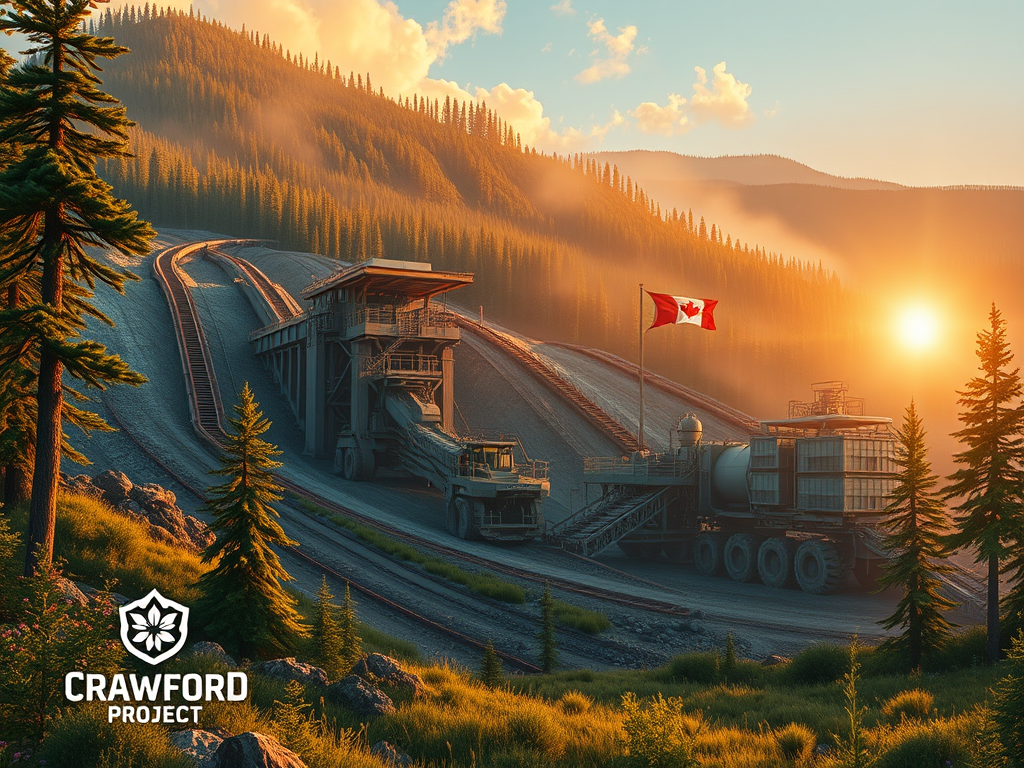
If Canada Nickel Company’s Crawford Mine Project becomes a reality by 2027, Timmins will have the second largest nickel mine in the world.

“Crawford is the world’s largest sulphide discovery in many, many decades,” said Selby, in an Oct. 12 conference call with mining analysts.

“We are unlocking, what we think is, a world-class, potentially the largest nickel sulphide district, globally. 

With an average grade of 0.22 per cent nickel, Crawford will be a low-grade, big tonnage open-pit operation that will ramp up production in three phases and physically expand twice over four decades.

The company is a third of the way through the regulatory permitting process and a financing plan to be put in place for the US$1.7-billion project.

Selby said they are less than 21 months away from making a final construction decision.

Read more at: https://www.timminstoday.com/local-news/canada-nickel-aims-to-build-worlds-second-largest-nickel-mine-in-timmins-7675840

#Qatar-#Burundi Business Forum reviews ways to enhance investment co-operation

Qatar Chamber hosted the Qatar-Burundi Business Forum recently to explore ways to enhance commercial and economic co-operation between the private sectors of both countries.

Qatar Chamber first vice-chairman Mr. Al-Kuwari said Qatari businessmen are keen to explore Burundi’s investment climate and opportunities. He said Burundi is rich in natural resources, such as nickel, uranium, copper, gold, and platinum, among others. Additionally, the country offers arable land.

Read more at: https://www.gulf-times.com/article/669627/business/qatar-burundi-business-forum-reviews-ways-to-enhance-investment-co-operation

Why the electric-vehicle industry is talking about ‘black mass’

The latest buzzword in battery materials sounds like a concept borrowed from astrophysics.

But “black mass” is just a very literal description of the intermediate product from recycling either spent electric-vehicle batteries or scrap from battery plants. It’s a dark, powdery cocktail of metals such as lithium, cobalt and nickel that’s emerging as a commodity in its own right.

There’s growing interest in battery recycling as the global electric-vehicle industry expands, and as carmakers and Western governments aim to build supply chains that bypass China.

Mentions of black mass in company earnings have grown — including recent instances from commodities trader Glencore and chemicals giant BASF. Three market researchers — Benchmark Mineral Intelligence, Fastmarkets and S&P Global — have launched regular price assessments of the material since April.

Read more at: https://www.japantimes.co.jp/business/2023/08/29/tech/hyperdrive-ev-industry-black-mass/

« Older Entries Recent Entries »