Category Archives: Related Inventions

U.S. must build EV batteries and advanced technologies at home

In August, Congress passed the Inflation Reduction Act, making a historic investment to rebuild industries that the U.S. invented but allowed China and other nations to capture. The legislation includes important production tax credits for critical mineral producers and refiners as well as manufacturers. But more is needed, including permitting reform, to gain energy independence from hostile nations such as China.

Credit Suisse estimates that the legislation’s tax incentives — combined with ensuing private capital investments — may total $1.7 trillion over the next 10 years. Having kicked off this green gold rush, it behooves us to now think about protecting these investments.

A particular threat is China’s domination of the world’s mineral supply chains, thanks to Beijing’s massive subsidies and predatory trade behavior.  World Trade Organization rules have proved fruitless in dissuading Beijing from using its alarming grip on raw materials as a source of geopolitical leverage.

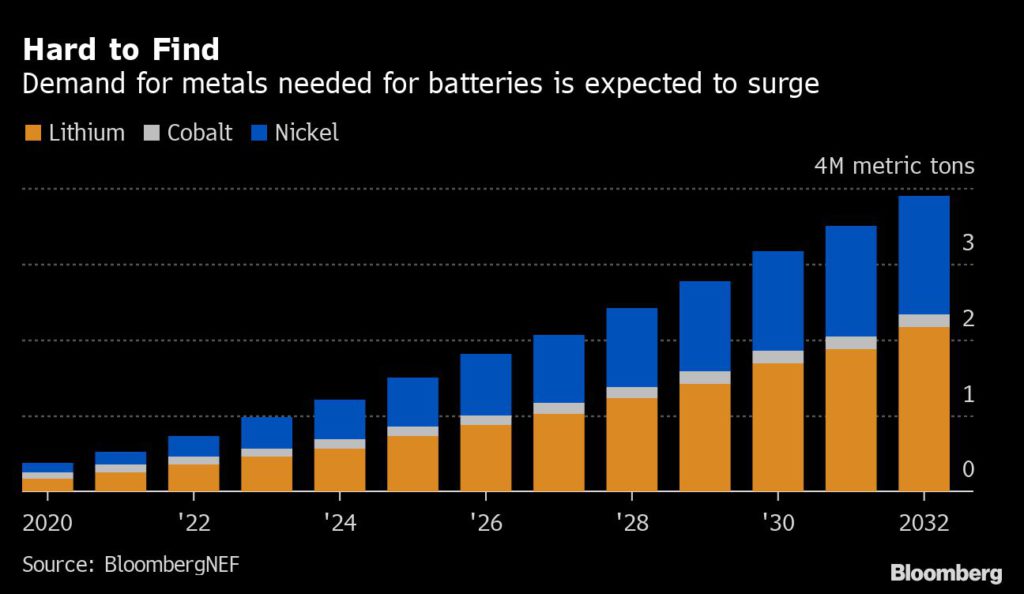
This will undoubtedly affect America’s electric vehicle (EV) ambitions. The building blocks for EVs are still largely imported — even as demand for key battery metals is exploding. It’s predicted that by 2040, the demand for EV inputs of lithium, nickel, graphite and cobalt could increase by a staggering 30 times. Unfortunately, China has already established a stranglehold on these resources, since Beijing controls 70% of the world’s lithium supplies and almost all of the world’s graphite. Especially concerning is China’s control of cobalt mines in the Democratic Republic of Congo that use child labor.

Read more at: https://www.washingtontimes.com/news/2022/oct/25/us-must-build-ev-batteries-and-advanced-technologi/

#Vale CEO says iron ore miner will spin-off #Copper, #Nickel unit

The chief executive of Vale SA said on Friday the Brazilian iron ore miner is reconsidering a near-term spin-off of its base metals business and an eventual public listing.

The Brazilian miner had a longstanding plan to sell the unit that was still being considered as recently as 2021.

But rather than selling all or part of it, the company is now looking to separate and ring-fence the copper and nickel unit from the iron ore business as the two have different growth prospects, Eduardo Bartolomeo said at the FT Mining Summit.

Read more at: https://www.reuters.com/markets/commodities/vale-ceo-says-iron-ore-miner-will-spin-off-copper-nickel-unit-2022-10-21/

#Biden hands out first EV battery metals funding

The White House selected 20 U.S. manufacturers and processors across 12 states for some of the first green metals funding from the US$135 billion pool initially approved almost a year ago in the Bipartisan Infrastructure Act.  
 
The U.S. is among countries in the West that want to lessen dependency on China, Russia and other regimes like the Democratic Republic of Congo that control global supplies in key minerals or mineral processing facilities needed for transitions to sustainable energy and widespread modern tech gadgets.

Read more at: https://www.northernminer.com/news/biden-hands-out-first-ev-battery-metals-funding-to-albemarle-piedmont-and-talon-among-others/1003847646/

#America Desperately Needs To Invest More In Battery Recycling

“The need for critical minerals is heightened with a focus on the electrification movement in transportation and will continue to accelerate”.

“Over the next five years, there will be more attention on recycled content and domestic supply.”

The last twelve months proved turbulent for the electrical products market. This is true whether you’re a raw material miner, refiner, manufacturer, or end user. Indeed, ongoing issues with battery metal prices and supply security affected millions. After demand rose dramatically, Chinese battery makers began snapping up resources left and right. This left major automakers scrambling to shore up supply agreements for raw materials and the associated downstream battery supply chains.

Both cost and security of supply have become significant concerns across both commercial and defense industries. In fact, these worries have made it all the way to the White House. As with rare earth metals, the reliance on overseas supply sources leaves the supply chain dangerously exposed.

What’s more, the companies see a closed-loop domestic recycling industry as critical. This is not only for self-sufficiency, but for environmental reasons. Without an adequate recycling industry, electronic components like batteries will only continue to end up in landfills.

Singapore Exchange (SGX)set to unveil EV metals futures

SINGAPORE: Singapore Exchange (SGX) is set to launch its first lithium and cobalt contracts, adding to efforts by commodity exchanges to get battery materials companies and investors interested in using futures.

SGX is due to kick off trading in two lithium and two cobalt contracts.

The London Metal Exchange (LME) and CME Group Inc already offer futures for both metals, although trading liquidity is still far below established commodities contracts.

Demand for battery minerals is expanding rapidly as the global auto industry accelerates a push toward electric vehicles, triggering big price swings.

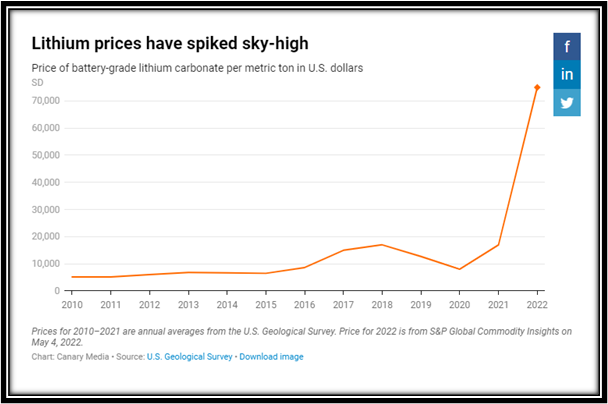
A global index of lithium prices has more than quadrupled in the past year, while Chinese lithium carbonate just hit a fresh record last week.

Read more at: https://www.thestar.com.my/business/business-news/2022/09/27/sgx-set-to-unveil————-ev-metals-futures

LG Energy inks #Cobalt, #Lithium supply deals with three #Canadian miners

SEOUL — South Korean battery maker LG Energy Solution said on Friday it has signed agreements on lithium and cobalt sourcing with three Canadian mining firms in a bid to expand its footprint in North America.

The Tesla supplier said in a statement the agreements were part of an effort to expand mid- to long-term supply contracts with companies that mine and process key battery materials in North America.

Read more at: https://financialpost.com/pmn/business-pmn/lg-energy-inks-cobalt-lithium-supply-deals-with-three-canadian-miners

#China May Find It Hard to Cool #Lithium’s Rally This Time Around

Scorching gains for lithium, a raw material vital for powering electric vehicles, threaten to push costs even higher for Chinese battery makers, and the government is finding itself powerless to do anything about it.

Even after a meeting last week where Chinese authorities pleaded with major producers to stabilize prices, lithium carbonate surged to a fresh record, rising to 500,500 yuan ($70,716) a ton. In yuan terms, that exceeds the level prevailing when Tesla Inc.’s Elon Musk called prices “insane” earlier this year.

“In the short term, I don’t think the meeting will help China cool the rally,” said Peng Xu, analyst at BloombergNEF. Prices for seaborne spodumene — a partly processed form of lithium — are increasing amid a supply-demand mismatch and that’s squeezing the margins of Chinese lithium refiners, Xu said, adding there’s still room for further gains from current price levels.

Read more at: https://www.bloomberg.com/news/articles/2022-09-22/china-may-find-it-hard-to-cool-lithium-s-rally-this-time-around

#CBC: Electric car batteries could boost #Glencore’s recycling operations

The growing market for electric vehicle batteries is expected to boost Glencore’s recycling operations in Sudbury, Ont.

The mining giant has been recycling metals at its Sudbury smelter for 32 years. 

Those alloys, which come from things like aircraft engine turbines or even parts from machine shops, are melted down, granulated and shipped to a facility in Norway, where they are separated into their base elements like nickel and cobalt.

Read more at: https://www.cbc.ca/news/canada/sudbury/battery-recycling-glencore-sudbury-1.6590472

#Glencore looking to trade #Lithium on soaring EV demand

Mining and commodity giant Glencore  is looking to add lithium to the suite of metals it trades, as the raw material is in hot demand due to the rapidly growing production of electric vehicles (EVs), two sources with knowledge of the matter said.

If it goes ahead, the Switzerland-based company’s trading team would be part of the zinc and copper business run by Jyothish George and Nick Popovic, the sources said.

Glencore declined to comment.

The company does not own lithium mines but produces copper, nickel and cobalt, other raw materials that it terms “commodities of the future,” as they are needed to manufacture batteries, electric cars and renewable infrastructure that will help the world transition to a greener economy.

Read more at: https://www.reuters.com/markets/europe/glencore-looking-trade-lithium-soaring-ev-demand-sources-2022-09-16/

Can #Indonesia’s electric car, battery sector have a smooth ride beyond #China?

  • US offers tax rebate for EV buyers whose vehicles’ batteries use minimal metal from ‘foreign entities of concern’, in reference to China, Russia firms
  • A lot of nickel, used for EV batteries, is from Indonesia, but experts say sector must become greener to gain more global market share.

A new regulation in the United States offering incentives to buyers of electric vehicles with battery components only minimally made by “foreign entities of concern” has paved the way for Indonesia to expand its burgeoning EV battery industry beyond the Chinese market.

However, the nation’s lacklustre green energy revolution may dampen that prospect in the future, analysts said.

The US Inflation Reduction Act (IRA), passed into law last month, offers a tax rebate of US$7,500 for EV consumers whose vehicles undergo final assembly in North America, and if their batteries use minimal metal components from “foreign entities of concern”, in a veiled reference to Chinese and Russian companies.

At least 40 per cent of the important metals in the EV battery, including lithium, nickel, cobalt and manganese, must also come from the US and its Free Trade Agreement partners. That percentage will rise to 80 per cent by 2026, according to Reuters. The new law will be effective until at least 2032.

There will be implications for Indonesia, “directly or indirectly, considering that China-made batteries imported by the US use Indonesian nickel”, said Putra Adhiguna, a Jakarta-based energy analyst in the transport sector at the Institute for Energy Economics and Financial Analysis. “But at this point in time, it’s unclear what the magnitude of that implication will be.”

While currently the largest markets for EV batteries are China and the European Union, “the Chinese market is still twice or three times bigger than the US market now,” Putra said.

But, Putra said that in the future, the US will be a “significant market” for nickel producers.

“The US is a significant growth market, so if they block products from China, and implement additional measures such as the IRA, our nickel industry’s future growth will feel the impact of the US’ drive to localise the EV supply chain.”

Read more at: Can Indonesia’s electric car, battery sector have a smooth ride beyond China? | South China Morning Post (scmp.com)

« Older Entries Recent Entries »