Category Archives: Metals

Roadmap for #US’ clean transportation future unveiled – #UCBerkeley

The Drive Rapid Innovation in Vehicle Electrification (DRIVE Clean) scenario, represents a future in which EVs constitute 100% of new U.S. lightduty vehicle (LDV) sales by 2030 as well as 100% of medium-duty vehicle (MDV) and heavy-duty truck (HDT) sales by 2035. The grid reaches 90% clean electricity by 2035, and substantial EV charging infrastructure is deployed.

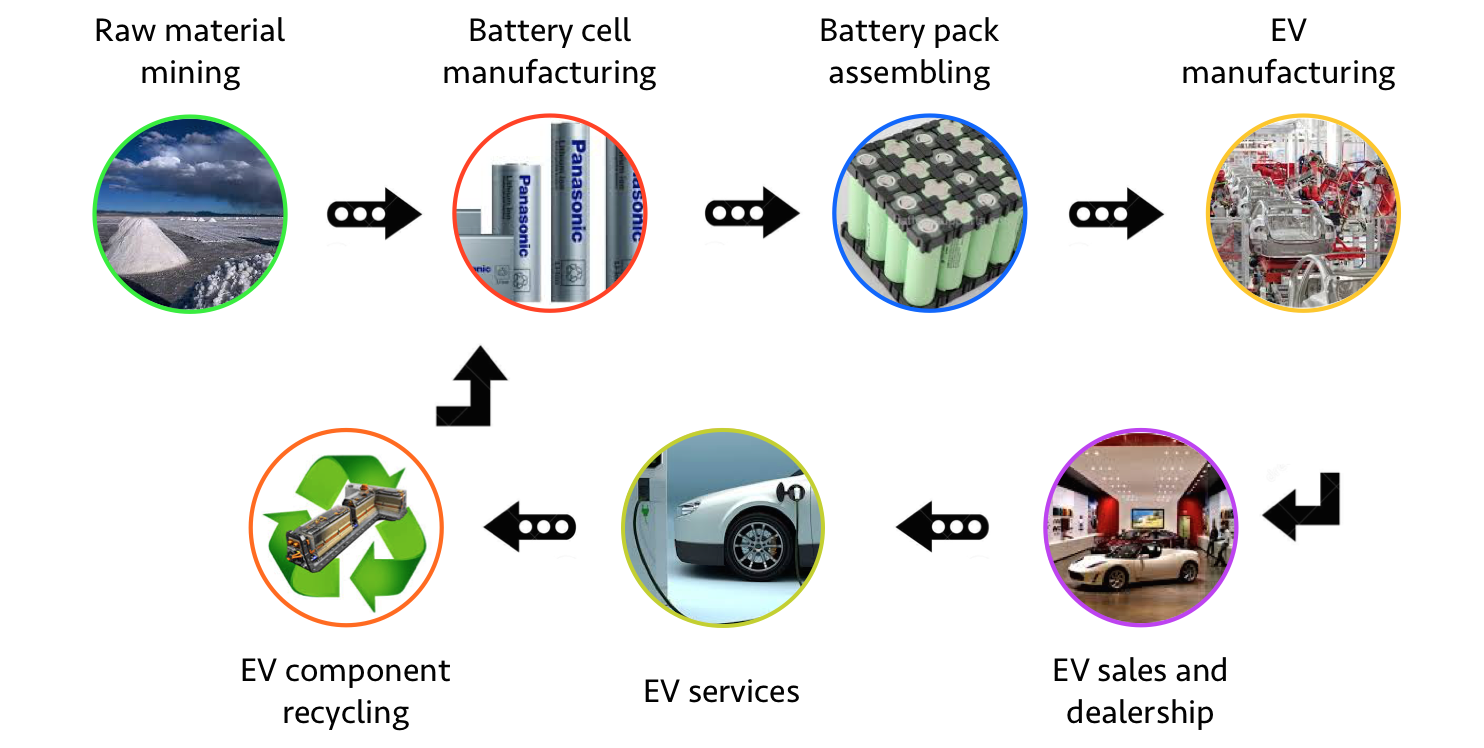
Battery recycling will be especially important for the United States as it achieves high-volume EV manufacturing in the 2020s and 2030s. The United States could meet about 30%–40% of anticipated demand for lithium, nickel, manganese, cobalt, and graphite in passenger EVs with recycled battery materials by 2035 (Reichmuth 2019).


Read more at: http://www.2035report.com/transportation/wp-content/uploads/2020/05/2035Report2.0.pdf?hsCtaTracking=544e8e73-752a-40ee-b3a5-90e28d5f2e18%7C81c0077a-d01d-45b9-a338-fcaef78a20e7

Car companies face a chip problem. Soon China will hand them a #cobalt problem that might trigger radical ownership moves

U.S. President #JoeBiden found out the hard way that supply chain obstacles are bad news for Corporate #America. He moved fast to hand US$50-billion to the U.S. semiconductor industry after chip shortages began to shut down auto production.

The chip glitch was a wake-up call for car companies, which had been spoiled by the endless supply of everything they needed to keep their assembly lines rolling – steel, aluminum, copper, rubber, glass, plastic, electronics. Even when their purchasing managers squeezed prices, the supplies kept coming. America the bountiful!

What Mr. Biden and automakers may not fully realize is that the chip shortage may just be the start of their supply problems. That’s because all the auto biggies are converting their fleets to electric power, which essentially means they are becoming battery companies. The economic and strategic risks of this move are enormous.

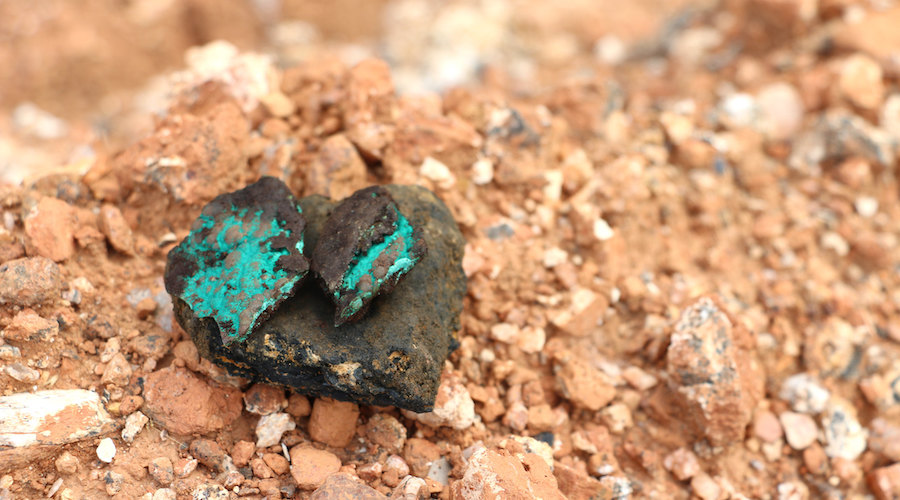
Since cobalt is an essential component of lithium-ion batteries, automakers will become beholden to the Democratic Republic of the Congo (DRC), where 75 per cent of the world’s cobalt is mined, and to the Chinese mining companies that dominate the metal’s production in that country. Switzerland’s Glencore may be the single biggest cobalt miner in the DRC, but it is the Chinese companies that are coming on strong and seem intent on taking over the global cobalt industry.

Chinese companies already account for 55 per cent of the DRC’s cobalt production; the figure would be 90 per cent if Glencore were to sell its cobalt mines to them (there is no indication Glencore is looking for a buyer, since cobalt is at the very heart of its “clean” metals mining empire, but everything has its price). China also controls most of the world’s cobalt refining.

Read more at: https://www.theglobeandmail.com/business/international-business/article-car-companies-face-a-chip-problem-soon-china-will-hand-them-a-cobalt/

#bloomberg: First #India EV Battery Plant Takes Shape to Cut #China Dependence

India’s biggest steel tycoon is betting big on converting coal tar into graphite anodes for electric-car batteries in a bid to test China’s monopoly in the sector.

Epsilon Advanced Materials Pvt– India’s first manufacturer of lithium-ion battery parts — plans to invest 60 billion rupees ($807 million) to produce 100,000 tons of synthetic graphite anode by 2030, or about 10% of estimated global demand.

Anode materials are the negative electrode in lithium-ion batteries and account for a quarter of a cell’s components. China has been producing more than 80% of the world’s supply of these anodes, importing raw materials from countries including India. By producing the anodes in India, Epsilon Advanced Materials Pvt aims to transition the South Asian nation from a battery minerals center to a battery materials hub.

Read more at: https://www.bloomberg.com/news/articles/2021-04-08/first-india-ev-battery-plant-takes-shape-to-cut-china-dependence

#GM offers clues to technology aimed at slashing EV battery costs

GM is experimenting with silicon-rich and lithium metal anodes, solid state and high voltage electrolytes, and dry processing of electrodes for its next generation of Ultium batteries, due around 2025.

The competition to fine-tune proprietary technology to cut electric vehicle battery costs is replacing horsepower wars as the battleground for deciding the industry’s winners and losers.

GM has said it aims to reduce battery cell cost to well under $100 per kilowatt-hour by 2025, compared with more than $150/kW today. GM executives also have said the company expects its future EV batteries to last for a million miles or more, with driving ranges of 500-600 miles (805 to 965 km) between charges.

That battery, which will be used in new GM electric vehicles such as the Hummer EV and Cadillac Lyriq, uses graphite-based anodes, nickel-cobalt-manganese-aluminum (NCMA) cathodes and liquid electrolyte.

GM said “the supply chain is going to explode” with demand for cobalt, nickel and other metals as GM and competitors ramp up EV production over the next five years.

Read more at: https://finance.yahoo.com/news/gm-offers-clues-technology-aimed-201625572.html

#THEwashingtonpost: #Biden’s plan to rev up the electric car market is complicated by battery supplies

President Biden’s ambitious plan to jump-start the U.S. electric vehicle market faces a roadblock: a weak supply chain that is making it difficult for American automakers to get enough batteries to scale up production.

And that short shortage could get worse, depending on whether Biden intervenes this week in a dispute between two top South Korean manufacturers over moves by one to open a battery plant in Georgia to serve the U.S. market. Hanging in the balance are plans by Volkswagen and Ford to roll out about 340,000 new electric vehicles over the next several years.

Read more at: https://www.washingtonpost.com/climate-environment/2021/04/04/electric-cars-batteries/

South China Mining Post: #Indonesia’s plans with #China’s #Tsingshan face pressure to uphold green standards

A new industrial estate for metal smelting that Indonesia plans to build with China’s steel and nickel giant Tsingshan Holding Group in Borneo will provide the country with much-needed investment to develop its electric vehicles (EV) battery industry, but environmentalists warned that the project needs to be managed carefully so as not to devastate the surrounding area and its communities.

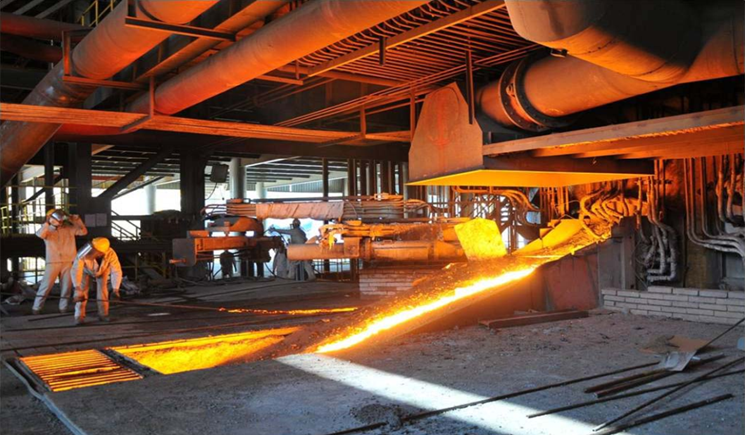
Luhut Pandjaitan, Indonesia’s coordinating minister for maritime affairs and investment, said last week that Southeast Asia’s biggest economy was in talks with Tsingshan and Australia’s Fortescue Metals Group to build a new industrial estate to host smelters for iron ore, nickel ore and copper – minerals critical to serving global demand for new technologies.

The smelters would be near an 11,000 megawatt-hydropower plant in North Kalimantan province, which is currently being built by Power Construction Corp of China (PowerChina) and Indonesia’s Kayan Hydro Energy. The first phase of the hydropower plant project is expected to be completed by 2025. 

Read more at: https://www.scmp.com/week-asia/economics/article/3128294/indonesias-plans-chinas-tsingshan-face-pressure-uphold-green

#Bloomberg – #SaudiArabia of #Cobalt: #Congo Eyes Battery-Metal Price Power

Democratic Republic of Congo, the world’s main source of vital battery ingredient cobalt, is also one of the poorest nations. And while it’s dominated by huge industrial mines, about a fifth of its silvery-blue metal is still hand-dug, in often unregulated and dangerous conditions.

Jean-Dominique Takis Kumbo, the head of the new state cobalt buyer, is determined to change that.

His Entreprise Generale du Cobalt will have a monopoly on all hand-dug cobalt in the central African country, giving it power to improve working conditions and potential control of nearly 15% of the world’s production. Takis says he’s hoping that’s a market share big enough to help influence cobalt prices the way Saudi  Arabian Oill Co., or Aramco, does with oil, and ultimately boost profit for the state.

Read more at: https://www.bloomberg.com/news/articles/2021-04-02/the-saudi-arabia-of-cobalt-congo-eyes-battery-metal-price-power

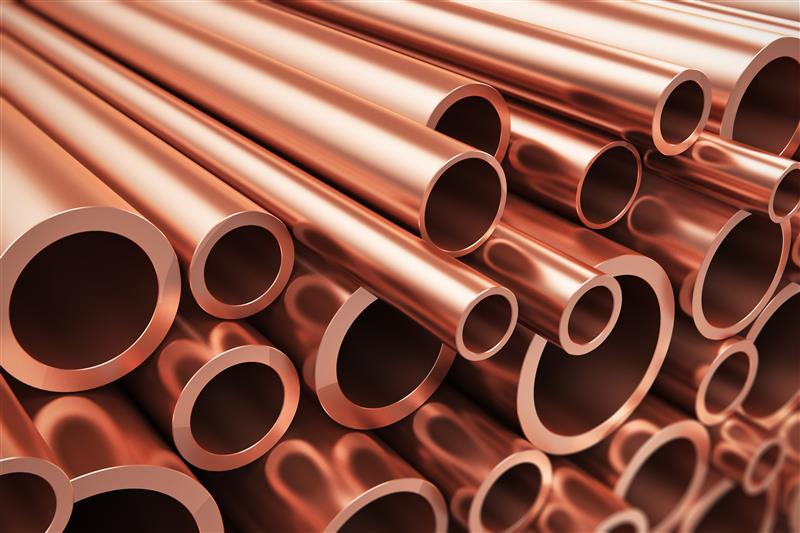
#Trafigura Sees Green #Copper Supercycle Driving Prices to $15,000

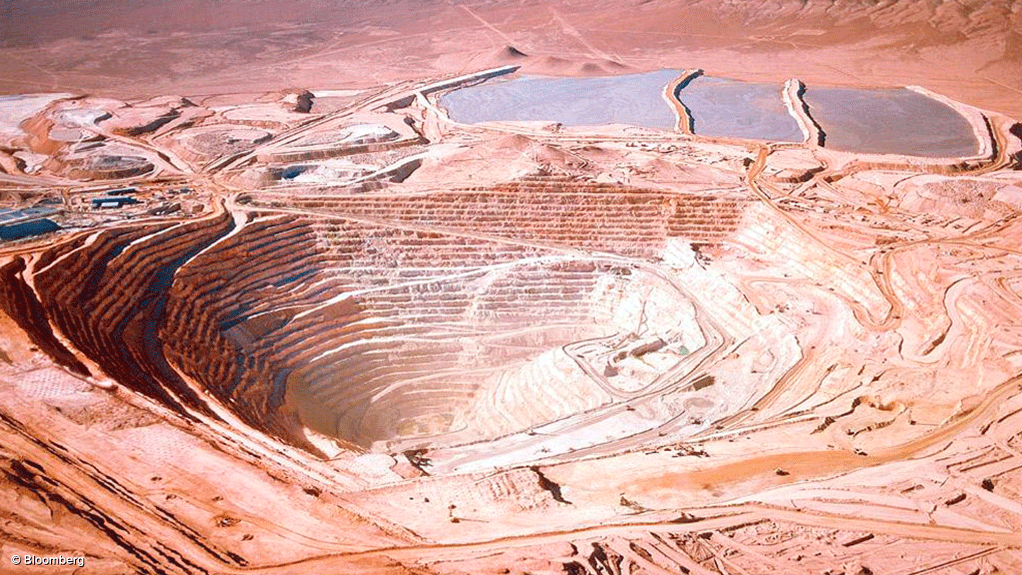
The world’s biggest copper trader expects the metal to hit $15,000 a ton in the coming decade as demand from global decarbonization produces a deep market deficit.

Even in the early stages  of the Covid-19 crisis, Trafigura Group was betting on the rebound that’s seen copper double over the past year to trade at more than $9,000 a ton. Now the commodities giant sees the metal soaring past record highs above $10,000 as western economies pull out of the pandemic and the green revolution takes hold.

Read more at: https://www.bloomberg.com/news/articles/2021-03-23/trafigura-sees-green-copper-supercycle-driving-prices-to-15-000

#MIT News: Study reveals plunge in #lithium-ion battery costs

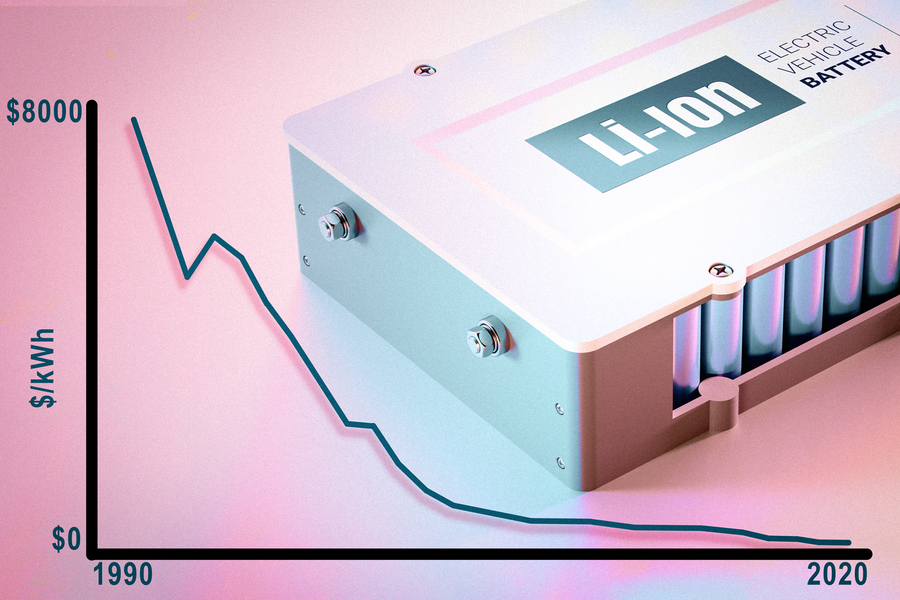
The cost of the rechargeable lithium-ion batteries used for phones, laptops, and cars has fallen dramatically over the last three decades, and has been a major driver of the rapid growth of those technologies. But attempting to quantify that cost decline has produced ambiguous and conflicting results that have hampered attempts to project the technology’s future or devise useful policies and research priorities.

Now, MIT researchers have carried out an exhaustive analysis of the studies that have looked at the decline in the prices these batteries, which are the dominant rechargeable technology in today’s world. The new study looks back over three decades, including analyzing the original underlying datasets and documents whenever possible, to arrive at a clear picture of the technology’s trajectory.

The researchers found that the cost of these batteries has dropped by 97 percent since they were first commercially introduced in 1991. This rate of improvement is much faster than many analysts had claimed and is comparable to that of solar photovoltaic panels, which some had considered to be an exceptional case. 

Read more at: https://news.mit.edu/2021/lithium-ion-battery-costs-0323

U.S. looks to #Canada for minerals to build electric vehicles -documents

The U.S. government is working to help American miners and battery makers expand into Canada, part of a strategy to boost regional production of minerals used to make electric vehicles and counter Chinese dominance.

On Thursday, the U.S. Department of Commerce is hosting a closed-door virtual meeting with miners and battery manufacturers to discuss ways to boost Canadian production of EV materials, according to documents seen by Reuters.

The move comes as demand for electrified transportation is set to surge over the next decade.

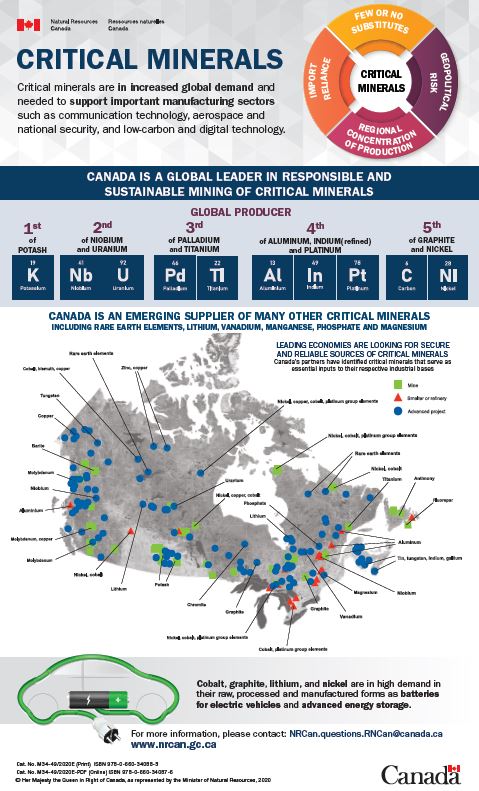
Conservationists have strongly opposed several large U.S. mining projects, leading officials to look north of the border to Canada and its supply of 13 of the 35 minerals deemed critical for national defense by Washington.

Read more at: https://financialpost.com/pmn/business-pmn/u-s-looks-to-canada-for-minerals-to-build-electric-vehicles-documents

« Older Entries Recent Entries »