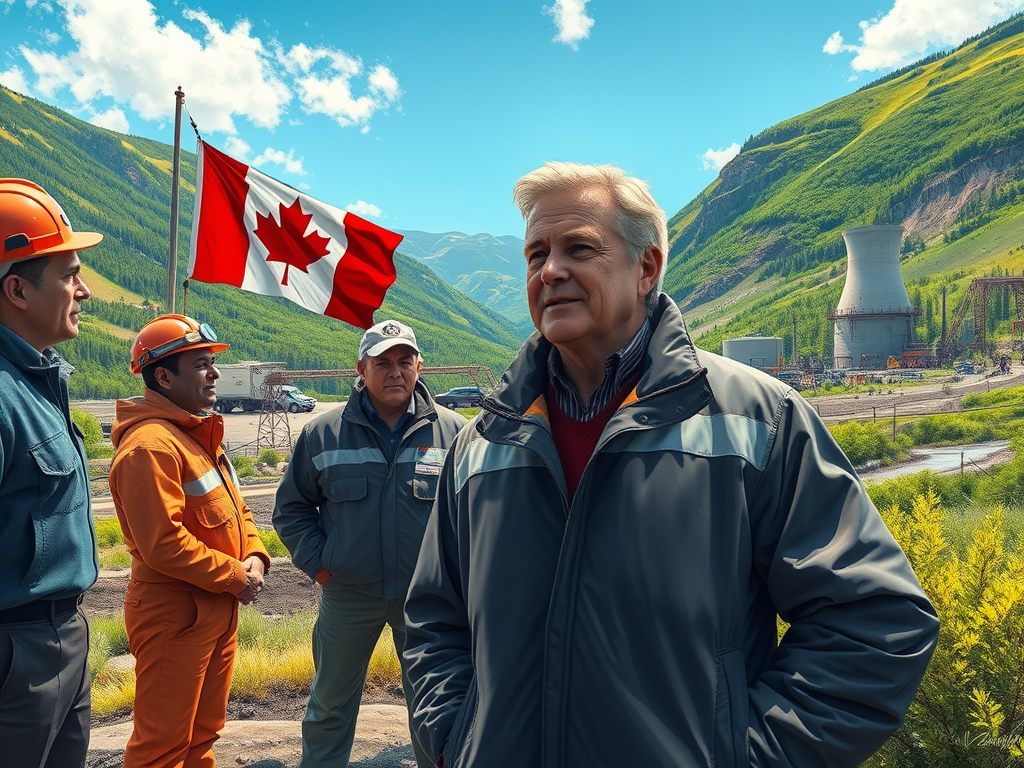
Canada Nickel Company has filed an independent technical report for the Mann Nickel Sulphide Project, which includes the Mann West and Mann Central properties. This report supports the initial mineral resource estimate for these deposits, highlighting their significant size and scale compared to the initial Crawford resource. The Mann Project, located in the Timmins Nickel District, is expected to bolster Canada Nickel’s position in the industry, with three additional resources anticipated by the end of 2025.
TOKYO—The U.S. found out this year that China could use its chokehold on rare-earth minerals as a coercive tool when Beijing imposed export controls. For Japan, it was déjà vu: It had been the victim 15 years earlier.
Tokyo vowed in 2010 to be ready for next time and over the years put hundreds of millions of dollars into Australian supplies. Yet as of last year, it was still relying on China for some 70% of its imports of rare earths, which are widely used in electronics, cars and weapons, according to the government-owned Japan Organization for Metals and Energy Security. When China restricted rare-earth exports in April, some of Japan’s automakers again got hit.
Japan’s experience drives home lessons for the U.S., where the Pentagon recently agreed to take a stake in Las Vegas-based MP Materials so it can mine and refine rare earths on American soil.
Tokyo found that partially reducing dependence still leaves Beijing with plenty of leverage. At the same time, complete independence costs billions of dollars, not millions. After the crisis passed and China resumed exports to Japan, the urgency to diversify supplies waned.
In an era where Africa seeks to unlock its full potential, few relationships better illustrate the power of regional cooperation than that between Tanzaniaand Burundi. Once defined primarily by shared history and border proximity, our partnership has evolved into a strategic alliance driving industrial growth, trade integration, and inclusive development.
A landmark example is the $2.15 billion Standard Gauge Railway (SGR) project signed earlier this year. Once completed, the 282-kilometre line connecting Uvinza in Tanzania to Musongati in Burundi will open a critical trade gateway to the Indian Ocean. It is expected to lower transport costs, expand market access, and boost industrialisation in both countries and beyond.
Despite abundant minerals, timber, and agricultural resources on the DRC side, trade flows remain imbalanced, with imports far exceeding exports. Addressing this mismatch ensures that regional integration is inclusive and equitable.
Yes, and the U.S. has abundant quantities of them also, but keeps them untapped subject to environmental opposition to mining them resulting in a regulatory minefield of local, state, and federal rules that has turned permitting into a costly decadeslong process.
In addition, many of the rare earths mined in the U.S. continue to be processed in China because it’s cheaper than having to pay American regulatory environmental and workplace safety costs.
One of the U.S. casualties was Molycorp, a. company that owned a Mountain Pass rare earth mine in California’s Mojave Desert that filed for bankruptcy in June 2015 after the surge in Chinese rare earth exports tanked prices.
Meanwhile, MP Materials is now gearing up to go toe-to-toe with China on commercial scale magnet production.
WASHINGTON, July 24 (Reuters) – The U.S. Interior Department on Thursday took steps to increase recovery of critical minerals, used in everything from electric vehicles to high-tech weapons, from mine waste, coal refuse, tailings and abandoned uranium mines.
Interior Secretary Doug Burgum directed his department to streamline federal regulations on the recovery of the minerals such as rare earths, lithium and cobalt from the waste.
The order directs the department to update guidance on making mine waste recovery projects eligible for federal funding and speed up reviews of plans to recover uranium and other minerals from abandoned mines. It also directs the U.S. Geological Survey to map and inventory federal mine waste sites.
The EU and China agreed on a new mechanism to help smooth the export of rare earth elements and magnets, as Brussels pushed Beijing to take its trade concerns seriously, European Commission President Ursula von der Leyen said after a summit in the Chinese capital on Thursday.
“We agreed – and this is new – to have an upgraded export supply mechanism. In other words, if there are bottlenecks, this upgraded support supply chain support mechanism can immediately check and solve the problem or the issue that is out there,” von der Leyen said.
China’s chokehold on rare earth exports has become one of the biggest issues in the EU-China relationship and was high on Brussels’ agenda as its leaders sat down with Chinese President Xi Jinping and Premier Li Qiang in separate sessions.
The tension stems from China’s decision to impose licensing requirements on the export of rare earth elements and magnets in April. The move was a response to US tariffs, but European firms were caught in the crossfire, with some production lines grinding to a halt.
Dar es Salaam. The planned groundbreaking ceremony for the Kabanga Nickel Project, set for October this year, will go ahead as scheduled despite BHP Group’s decision t sell its 17 percent stake in Kabanga Nickel Limited (KNL) to Lifezone Metals Limited.
Lifzone, the parent company of KNL, announced on July 18 that it had completed a definitive agreement with BHP Billiton (UK) DDS Limited to acquire the mining giant’s entire equity interest in KNL. As a result, Lifezone now owns 100 percent of KNL, which in turn holds an 84 percent stake in Tembo Nickel Corporation Limited (TNCL) – the operating equity for the Kabanga project.
Apple’s plan to make AirPods in India has hit a speed bump, and it has to do with a key material that’s mostly controlled by China. According to a report by Moneycontrol, the issue lies in the supply of dysprosium, a rare earth metal used in tiny magnets that help AirPods work the way they do. Foxconn, the company making these AirPods in India at its Telangana factory, has been struggling to get enough of this material. And it’s not because of internal mismanagement. The problem is bigger, and it’s political. China recently tightened export rules on dysprosium and other rare earth materials, and that’s made things difficult for companies operating outside the country.
In April, President Donald Trump issued an executive order expediting U.S. licensing of seabed mining, departing from international law to unleash what the administration called a “gold rush” to “counter China’s growing influence.” The country is set to conduct ISA-sanctioned tests of two seabed mining machines in the Pacific over the next year.
Within days of Trump’s order, Canadian-registered TMC’s U.S. subsidiary filed the world’s first application to mine the seabed in international waters, including an area it licenses from the ISA. An $85 million investment from a leading Korean metals processor soon followed.
Mann Central holds 520,000 million tonnes of nickel in the indicated category, grading 0.22 per cent, with 1.15 million tonnes on the inferred side at a grade of 0.21 per cent
Canada Nickel is pitching itself as a potential district-scale miner with a series of low-grade, but large-tonnage mining prospects. Mann Central and Texmont are, for the most part, no different. The company said what it has in the ground is on par with Sudbury’s 19-million-tonne nickel endowment.
Mann Central holds 520,000 million tonnes of nickel in the indicated category, grading 0.22 per cent, with 1.15 million tonnes on the inferred side at a grade of 0.21 per cent